Languages: English (official); Afrikaans (official); Herero (other); German (other); OshiKwanyama (other); Nama (other)
Where to go in Namibia
Etosha National Park
Etosha National Park, Namibia is a scrubby savannah that defines the western part of the park, while further east, the landscape is made up of mixed woodland. However, the surrounding bush and grasslands provide a home for 114 mammal species and 340 bird species. Meaning ‘great white place’, the salt pans are what defines the Park. A strong contrast to the white terrain is when the flamingos flock to the pan’s edge creating a pink hue only seen in picture books. It is also known as ‘place of dry water’ because the pan is usually very dry, occasionally filling with water for brief periods in the summer, attracting pelicans, flamingos, black rhino and black-faced impala.
The Fish River Canyon
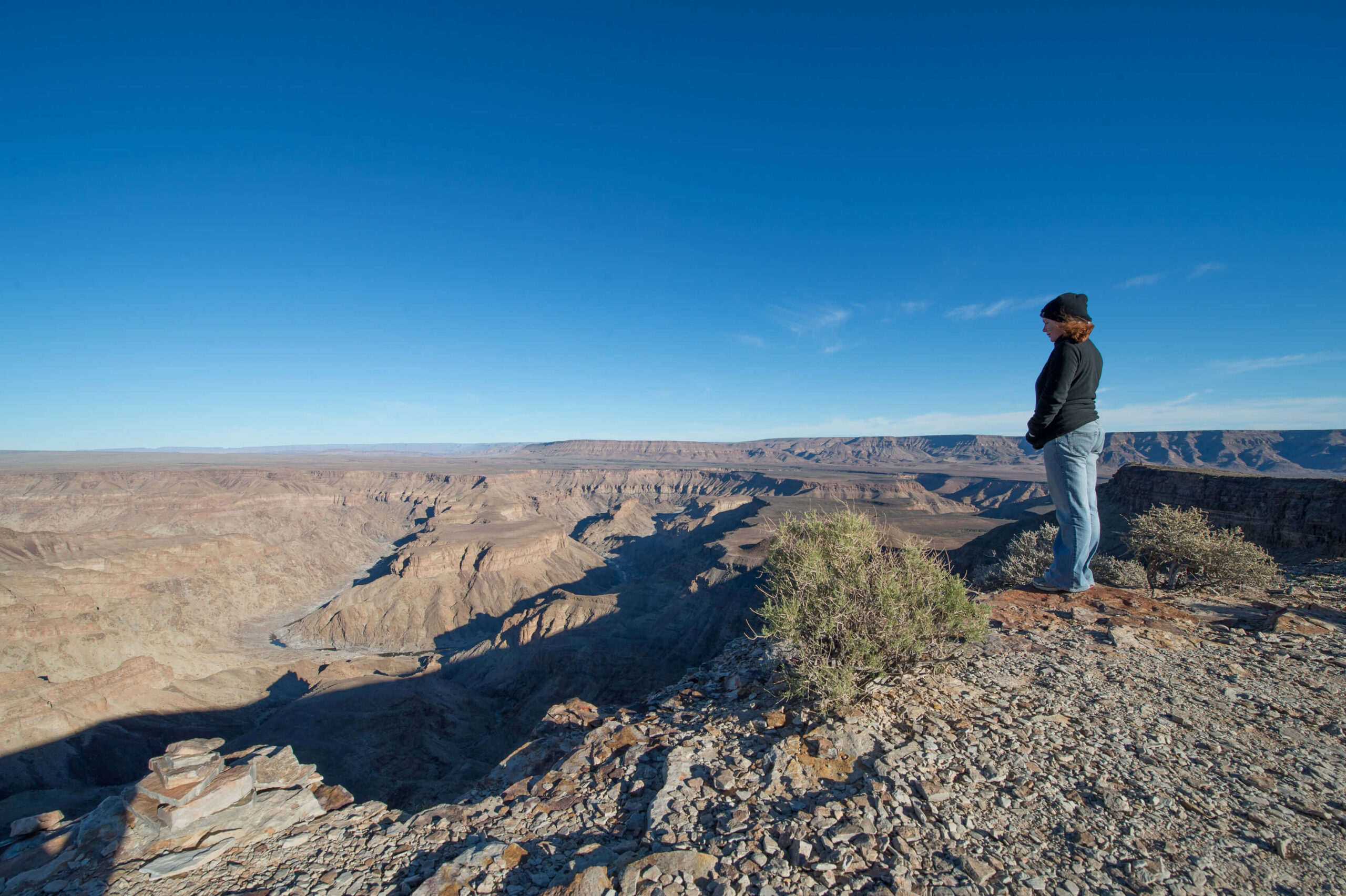
The mighty Fish River Canyon is the second largest canyon in the world, leaving you breathless as you take in all its glory. Several mammals, reptiles, insects and fish live in the natural pools of this unusual habitat. Hiking around this area is a popular sport and well-worth the effort.
The Skeleton Coast
On the Skeleton Coast you can visit the many shipwrecks that scatter the shores and have given this eerie place its nickname of ‘the land God made in anger’. When sailors were washed ashore here, they had no chance of survival. To add to this, there’s a misty fog that hangs in the air for most of the year. Here you can see clay castles, experience the salt pans, hike the dunes, view the rock engravings, go on desert walks and drives and take a flight over the coast.
The Namib-Naukluft National Park
The Namib-Naukluft National Park is bordered by the Namib Desert (considered the oldest in the world) in the west and the Kalahari Desert in the east. The reserve’s dry southern location provides every visitor with exquisite views. It is the most versatile conservation region of Namibia, and is one of the country’s main tourist destinations. This expansive wilderness is bigger than Germany, reaching the size of around 49,768 square kilometres, making it the biggest game park in all of Africa and the fourth biggest in the world. It also encompasses vital features, including Sossusvlei, Sesriem, the Welwitschia Trail, Sandwich Harbour, the Naukluft Mountains and the Kuiseb Canyon. There is a variety of landscapes in the Park, such as dunes, gravel plains and rugged mountainous regions. The reserve is one of the least populated areas in the country, giving guests a true sense of the nature and enormity of the Park, providing beautiful and clear evening skies.
An astonishing assortment of animals inhabits this arid area, such as hyena, gemsbok, jackal, snakes, geckos and intriguing insects such as the Namib desert beetle, a unique insect that collects water on its back. Moisture enters the Park as fog that floats off the Atlantic Sea then falls as rain, giving the region an annual rainfall of approximately 106 millimetres, all between the months of February and April. The winds that help in bringing this fog in are also responsible for forming the Park’s massive sand dunes that show their age with their burnt orange hue. Sossusvlei’s dunes are amongst the highest in the world, rising in certain areas to heights of over 400 metres above the desert ground. Lagoons, wetlands and mudflats draw in an abundance of birdlife.

Namib means ‘open space’, and the Namib Desert offered its name to help create ‘Namibia’, which means ‘land of open spaces’. The reserve was founded in 1907 after the German Colonial Administration declared the region between the Swakop River and the Kuiseb River a game park. The Naukluft portion completes the other half of the Namib and includes such features as the Naukluft Mountains and huge rock formations that make the region a geologist’s heaven. The reserve contains five different vegetation communities that result in plenty of tree and shrub vegetation, and a wide range of aloes. In addition to the Hartmann’s mountain zebra found here, there are also plenty of kudu, gemsbok, klipspringer, duiker, steenbok, leopard, baboon, black-backed jackal, bat-eared fox, African wild cat, caracal and aardwolf. Naukluft’s steep escarpments are the nesting lands for numerous cliff-breeding bird species, including majestic Black eagles.
The Naukluft Mountains are located in the northeast of Sesriem, where the primary slope juts out into the desert, creating a range that is known as the Naukluft Mountains. These mountains were guarded within the Park in 1968 in order to protect a rare breeding concentration of Hartmann’s mountain zebra. Briefly following this, land was purchased to the west of the mountains and was joined to the reserve, thus creating a corridor that links the mountains to the Park. This permitted oryx, zebra and other wildlife to migrate between the two regions, and in 1979 the reserves were eventually combined to form the Namib-Naukluft National Park. Though most of the land in the Park tends to be rocky and lightly peppered with plant life, the ravines and valleys are lush. The area boasts an incredible variety of fauna and flora, and is a scenic must-see for anyone preparing a visit to Namibia.
Sossusvlei
Sossusvlei is a salt and clay pan amid towering red dunes in the southern part of the Namib desert, which is part of the Namib-Naukluft National Park. Rust-red dunes mark this territory by rising 300 metres above the valley floor, a spectacular sight to see.
The Spitzkoppe
The Spitzkoppe is very popular with rock climbers all over the world due to their granite peaks, with the highest outcrop being 1784 metres above the desert floor. The peaks are for seasoned rock climbers, but despite this there are many conquests of these rocky outcrops. So if you are looking for adventure and a good challenge, why not try your hand (or feet!) and conquer one of these peaks.
Swakopmund
Swakopmund is a seaside resort with a difference, since it’s surrounded by the harsh Atlantic Ocean, a strip of foggy coastline, windswept dunes and barren gravel plains. There are plenty of action-packed activities for adrenalin junkies such as skydiving, hot-air ballooning, paragliding over the dunes, quad biking and sandboarding. However, there are also leisurely safari drives, tranquil fishing spots, an interesting museum to visit, the national Aquarium, or a boat cruise to visit the dolphins and seal colonies.
Windhoek
The capital and largest city of the Republic of Namibia, Windhoek is the social, economic and cultural hub of the country. It is a very vibrant city with much to see and do. Many African safaris begin here, so make sure to spend some time exploring the city before you head off into the desert.
The Caprivi Strip
The Caprivi is a narrow strip of land north-east of Namibia and has considerably more rain than the rest of Namibia, hence the Okavango and the Kwando rivers. This changes the landscape and vegetation slightly and you have extensive floodplains, floating papyrus swamps and lush riverine forest.
Damaraland
Damaraland has a dramatic landscape of red-hued mountains, enormous granite koppies (hills) and wide, open, sandy plains. It lies south of Etosha National Park and north of Swakopmund. Some of the highlights are the bushman paintings in Twyfelfontein, and learning more about the way they used to live off of the land.
Back to top
Related Articles on Namibia:
[aesop_collection collection=”165″ limit=”10″ columns=”2″ splash=”off”]
5 Reasons to go on Safari in Namibia
Etosha Safari on a Budget
Namib Desert
Sossusvlei
Damaraland
Caprivi Strip
Swakopmund
The Perfect African Sunrise
Spitzkoppe
Twyfelfontein Rock Paintings
Namibian Potjiekos Recipe
The Himba Tribe
Etosha – ‘Place of dry water’