

African Overland Tours
Here is a guide on yellow fever requirements for East and Southern Africa, aimed at clarifying the situation for clients travelling from countries with no risk of yellow fever transmission, specifically to Southern Africa. Updated: 06 October 2026
Understanding Yellow Fever and Transmission Risk
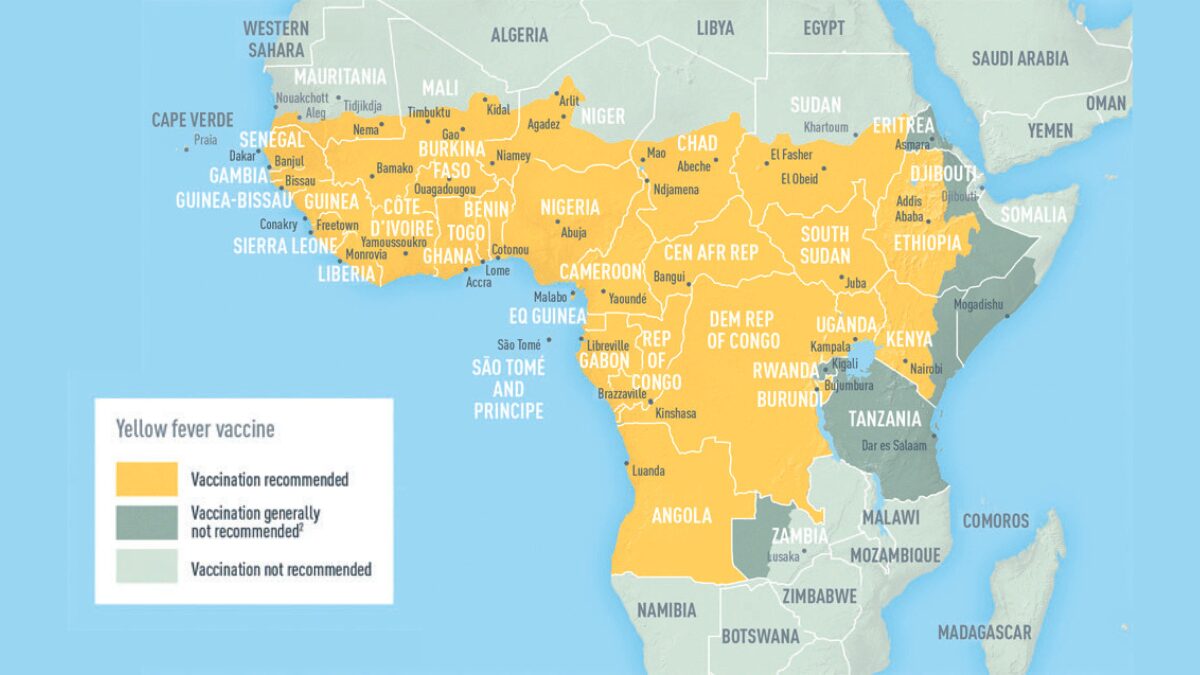
Yellow fever is a viral disease spread by infected mosquitoes. The risk of contracting yellow fever is concentrated in specific regions of Africa and South America. The World Health Organization (WHO) maintains a list of countries with a risk of yellow fever transmission. It's important to understand that even if a country doesn't require a yellow fever certificate for entry, there might still be a risk of yellow fever transmission within that country. Few travel health topics generate as many confused pre-trip emails as yellow fever. The confusion is understandable — the rules genuinely differ from country to country, and a handful of important details (which countries ask for it only in specific circumstances, why a country with no entry requirement can still trigger one further down your route, and what counts as valid proof) rarely make it into the average packing-list blog post. This guide clears all of that up.| Destination | Entry Policy |
Details / Exceptions
|
| Uganda | Not required for entry |
Uganda's immigration authority confirmed in 2026 that the certificate is no longer mandatory. Uganda is still a yellow fever risk country, so you may need the certificate for the next country on your route.
|
| Rwanda | Conditional |
Required for arrivals aged 1+ from a yellow fever risk country (including Uganda and Kenya) or an outbreak country. Not required on direct flights from non-risk countries such as the UK, US or Europe.
|
| Kenya & Tanzania | Conditional |
Required only if arriving from or transiting >12 hours through a WHO-listed risk country (this includes Uganda).
|
| South Africa & Botswana | Conditional |
Strictly enforced for any traveler arriving from an endemic zone (including Uganda and regional cross-flights).
|
Key Factor: Your Country of Origin and Transit
The main thing determining whether you need a yellow fever vaccination certificate for Southern Africa is where you are travelling from and if you have recently been to or passed through a country with a risk of yellow fever transmission. For example, if you are travelling from a yellow fever risk country, such as Uganda or Kenya, you will generally need a yellow fever vaccination certificate to enter most Southern African countries.Southern African Countries and Yellow Fever Certificate Requirements (for travellers NOT coming from risk areas)
Generally, if you are travelling directly from a country with no risk of yellow fever, most Southern African nations do not require you to have a yellow fever vaccination certificate. These countries recognise that the risk of you carrying the disease is very low. The following Southern African countries generally do not have a specific yellow fever certificate requirement for travellers arriving directly from countries without risk of yellow fever transmission:- Botswana
- Eswatini (Swaziland)
- Lesotho
- Malawi
- Mozambique
- Namibia
- South Africa
- Zambia
- Zimbabwe
Countries NOT Considered to have a Risk of Yellow Fever Transmission (as of October 2026)
This is not a complete list, and it can change, so always check official sources. However, common examples include:- North America: Canada, United States, Mexico
- Europe: United Kingdom, France, Germany, Italy, Spain, etc.
- Australia and New Zealand
- Many parts of Asia
Why Verification is Crucial
While the general rule is often that you don't need the vaccination if coming from a non-risk country, it is absolutely essential to verify the specific entry requirements of each Southern African country you plan to visit. These regulations can change without notice.How to Check the Requirements:
- Embassy or Consulate of the Destination Country: The official website or contact information for the embassy or consulate of the Southern African country in your country of residence is the most reliable source.
- Government Travel Advisories: Your own government's travel advice website (e.g., GOV.UK for British travellers, travel.state.gov for US citizens) often includes health information and entry requirements.
- National Travel Health Network and Centre (NaTHNaC) or World Health Organization (WHO): These organisations provide comprehensive information on travel health, including vaccination requirements. You can find a list of countries with risk of yellow fever transmission on the WHO website.
- Your Travel Agent or Airline: They may have up-to-date information, but always double-check with official sources.
Yellow Fever in East Africa:
Several East African countries are considered to have a risk of yellow fever transmission, but their entry rules differ. Kenya, Tanzania and Rwanda ask for a certificate if you arrive from, or have transited through, a risk country. Uganda no longer asks for one at entry. If your itinerary combines countries, check each border on your route.Uganda and Rwanda: the unconditional requirement
Uganda: no certificate needed for entry Do you need a yellow fever certificate to enter Uganda? No. Uganda's National Citizenship and Immigration Control confirmed in a letter dated 27 August 2026 that a yellow fever vaccination certificate is no longer a mandatory requirement for entry. It has also been removed from the e-visa application portal. That doesn't mean Uganda is risk-free. Uganda is still a yellow fever risk country, and health authorities still recommend vaccination for travellers visiting. It also means that travelling from Uganda can trigger a certificate requirement at your next border. If you're combining a gorilla trekking add-on in Uganda with Kenya, Tanzania, Rwanda or Southern Africa, carry your yellow card for those crossings. Some government and visa pages haven't caught up with the change yet, so you may still see older guidance online. If you'd like written confirmation, Uganda's immigration Public Relations office is the official contact. Rwanda: required if you're arriving from a risk country Rwanda asks for a certificate from travellers aged one and over who are arriving from a yellow fever risk or outbreak country. Flying in directly from a non-risk country (most of Europe, North America and Australia) generally doesn't trigger it. Crossing the land border from Uganda or arriving via Nairobi does count as arriving from a risk country, so a gorilla trekking itinerary that links Uganda and Rwanda can still need the card. Rwanda also treats a certificate as invalid within 10 days of vaccination.Kenya and Tanzania: it depends on where you're coming from
Kenya and Tanzania take a different approach: you only need proof of vaccination if you're arriving from, or have spent 12 or more hours transiting through, a country with yellow fever risk. If you're flying directly from a non-risk country (most of Europe, North America, and Australia, for instance), you generally won't be asked for it. Where this catches people out is on combined itineraries — flying into Nairobi via Addis Ababa, for example, or crossing the land border from Uganda into Kenya, both count as arriving "from" a risk country and can trigger the requirement even though your ultimate starting point never required it. The same logic applies to Tanzania, which lists Uganda and Kenya among the countries whose arrivals need a certificate. With Uganda's entry requirement gone, this is now the situation most East Africa overlanders will actually meet. Worth knowing: Tanzania itself is not classified by the World Health Organization as a yellow fever risk country. The requirement above is about where you're arriving from, not risk within Tanzania itself. PLEASE NOTE: Although the CDC says you don't need it for Tanzania, it is often asked for at the border when arriving in Tanzania or on your return home. We recommend still obtaining it for Tanzania.In Conclusion:
If you are travelling to Southern Africa directly from a country with no risk of yellow fever transmission, they most likely will not need a yellow fever vaccination certificate. However, it is paramount that they always confirm the latest entry requirements for each country on their itinerary through official channels to ensure a smooth trip. For travel involving transit through risk countries or travel from risk countries, vaccination is usually required.Four details that trip people up
- Your certificate is valid for life. Following a World Health Organization rule change in 2016, a single yellow fever vaccination now provides lifetime validity — there's no longer a 10-year booster requirement. If you were vaccinated any time in the past and have the certificate to prove it, you don't need a repeat dose, regardless of how long ago it was.
- It must be the original physical card. The International Certificate of Vaccination or Prophylaxis — universally known as the "yellow card" — needs to be the original document. A photocopy or a photo on your phone is not accepted at most borders. Keep the physical card with your passport, not packed away in checked luggage.
- Vaccination needs to happen at least 10 days before you travel. The certificate isn't considered valid until 10 days after the vaccine is administered, so getting it the day before you fly won't satisfy the requirement — you'll need to build this into your pre-trip planning timeline, ideally four to six weeks out alongside any other travel vaccines.
- Carry it even if you don't think you'll need it. Uganda no longer asks for the card at entry, but Kenya, Tanzania, Rwanda and South Africa can ask for it when you arrive from Uganda. Land border posts and connecting flights can trigger the requirement in ways that aren't obvious from your itinerary alone. If there's any yellow fever risk country on your route, even just a layover, bring the certificate.
https://www.tripadvisor.co.uk/Attraction_Review-g312659-d13131637-Reviews-African_Overland_Tours-Cape_Town_Central_Western_Cape.html
https://www.reviews.io/company-reviews/store/africanoverlandtours-com
https://www.facebook.com/AfricanOverlandTourscom/
https://www.instagram.com/african_overland_tours/
https://www.tiktok.com/@africanoverlandtours
https://uk.trustpilot.com/review/africanoverlandtours.com
https://www.youtube.com/@africanoverlandtoursandsafaris
+27 (0) 21 448 0997
Customer Service
Worldwide