Botswana likes to describe itself as one nation rather than a patchwork of tribes, and in many ways it is.
Unlike almost anywhere else in Southern Africa, this is a country that emerged from independence in 1966 with a deliberate, constitutionally-embedded push toward a single Batswana identity — a “we’re all Batswana first” ethos that has helped keep Botswana one of the continent’s most stable democracies for nearly sixty years running. And yet spend any real time on the ground — poling down a channel in the Okavango Delta, watching dancers gather at a festival near Francistown, or sharing a fire with a San guide in the Kalahari — and it becomes obvious that “Batswana” is really an umbrella over a genuinely diverse set of peoples, languages, and histories.
That’s the paradox of travelling in Botswana. Most visitors come for the wildlife — the Delta’s channels, Chobe’s elephants, Moremi’s leopards, the vast salt-white nothing of the Makgadikgadi — and leave, if they’re lucky, having also met a Mmbukushu basket-weaver in the Panhandle, a Bayeyi mokoro poler born within sight of the channel he’s poling, or a Naro tracker in the Kalahari reading spoor most of us would swear was unmarked ground. Botswana’s landscapes are extraordinary. Its people, and the very different histories that brought them to this particular stretch of Southern Africa, give an overland trip through the country a second layer worth paying attention to.
This guide works through Botswana’s peoples in three broad groupings: the Bantu-speaking majority who make up the overwhelming bulk of the population and dominate the country’s political and economic life; the Khoisan or “click-language” San, among the oldest documented cultures on the planet and Botswana’s original inhabitants; and a smaller, final group of communities — European-descended and Indian Batswana among them — whose presence traces to more recent migration. Alongside the history of each, we’ve included practical, respectful ways to actually meet these communities on the ground, because Botswana’s community trusts and conservancies are, at their best, some of the more genuine models of community-owned tourism anywhere in Africa.
A quick note before we start: every group below is a living, contemporary community, not a museum piece. Batswana of every background wear jeans and traditional dress, herd cattle and hold office jobs, attend kgotla meetings and use smartphones — often the same person, on the same day. Keep that in mind as you read, and especially as you travel.
Voluminous Victorian-style dress and cow-horn headdresses (otjikaiva); resilient cattle herders.
Basubiya
Included in ~7% “Other”
~15,000
Chobe / Kasane
Bantu
Zambezi basin river economy; skilled fishing, floodplain farming, and intricate basketry.
White & Indian
Included in ~7% “Other”
~20,000
Urban centres, Ghanzi farms
Indo-European / Indo-Aryan
Commercial farming, urban retail sectors, and post-independence business development.
(The 79% / 11% / 3% figures are the standard, widely-cited estimates for the three largest groups; the remaining roughly 7% covers everyone else, including the Bakgalagadi, Bayeyi, Hambukushu, Herero, Basubiya, and small White and Indian communities. Botswana’s census does not break ethnicity down further than this at a national level, partly a reflection of the country’s deliberate post-independence policy of downplaying tribal categorisation in official data.)
Traveler’s Guide: Prefixes and Clicks in Botswana
1. The Bantu Grammar Key
In Setswana and related languages, noun prefixes tell you whether you are talking about a language, a person, or the tribe as a whole.
Se- denotes the language (e.g., Setswana is the language).
Mo- denotes a single person (e.g., a Motswana is one citizen; a Moyeyi is one person from the Yeyi tribe).
Ba- or Ma- denotes the people collectively (e.g., the Batswana people; the Bayeyi people).
2. Reading San Click Symbols
When you interact with Naro or Ju/’hoansi San guides, you’ll encounter punctuation marks inside words. These represent distinct click consonants:
/ (Dental click): Expresses mild surprise or disapproval—like making a “tsk-tsk” sound. (e.g., Ju/’hoansi)
! (Alveolar click): A sharp “pop” sound made by pulling the tip of the tongue down from the roof of the mouth, like a cork coming out of a bottle. (e.g., !Xoo)
// (Lateral click): Made along the sides of the tongue, mimicking the sound used to encourage a horse to walk. (e.g., G//ana)
Part One: The Bantu-Speaking Majority
Botswana’s Bantu-speaking peoples arrived in successive waves of migration beginning many centuries ago, eventually establishing the cattle-and-kgotla society that still shapes the country’s political culture today. Together they make up close to 97% of the national population, and their histories — some overlapping, some in open conflict over the centuries — are woven through nearly every region of the country.
1. The Tswana (Batswana) — the nation’s namesake and its governing culture
Botswana takes its name and its dominant civic identity from the Tswana, who make up close to four in every five people in the country. But “Tswana” isn’t really one tribe so much as eight related chiefdoms, or merafe: the Bangwato (by far the largest, historically centred on Serowe), the Bakwena, the Bangwaketse, the Bakgatla, the Barolong, the Batlokwa, the Balete, and the Batawana, whose territory centres on Maun and the Okavango. Each merafe traditionally has its own kgosi (chief) and its own kgotla — an open-air meeting place and the beating heart of Tswana governance, where disputes are aired, decisions are debated, and, crucially, anyone present is entitled to speak. It’s a genuinely old form of participatory democracy, and it’s not an accident that Botswana, alone among most of its regional neighbours, has never experienced a coup or a serious civil conflict since independence; many historians and Batswana themselves point straight back to the kgotla tradition as part of the reason why.
Cattle sit at the centre of traditional Tswana life in much the same way they do for pastoralist cultures across Southern Africa — a measure of wealth, a bride-price currency, and a form of savings that survives drought and economic downturn better than currency does. Traditional Tswana homesteads (lolwapa) are built around walled courtyards, and villages are laid out with the kgotla, not a church or a market, as the geographic and social centre.
Visiting respectfully
Because Tswana communities and culture are so thoroughly woven into everyday Botswana life — in Gaborone, Serowe, Maun, and every village along the way — a genuine cultural encounter here is less about seeking out a dedicated “tribal visit” and more about paying attention as you travel. If your route passes through Serowe, the Khama III Memorial Museum tells the story of the Bangwato royal family and Botswana’s independence movement in real depth. Sitting in on a kgotla meeting isn’t something to request casually, but if your guide has a genuine local connection and the timing works, it’s one of the more quietly remarkable things you can witness in the country — a live, functioning example of consensus government that predates the nation itself.
2. The Kalanga (BaKalanga) — Botswana’s second-largest people and a deep pre-colonial history
Centred on Francistown and the surrounding northeast, the Kalanga are Botswana’s second-largest ethnic group, tracing their ancestry to the Kingdom of Butua and, further back, to the Shona-related states — including Great Zimbabwe itself — that once controlled trade routes running from the interior to the Indian Ocean coast. That deep history is written into the landscape: the Domboshaba ruins, roughly 75km north of Francistown, are a stone-walled royal site dating to around 1440, built by ancestors of today’s Kalanga, and among the most significant pre-colonial archaeological sites in the country.
Kalanga culture places particular importance on rainmaking traditions — ritual specialists historically petitioned for rain at sacred sites, a practice tied closely to the agricultural cycle that has sustained Kalanga communities for centuries — alongside a strong tradition of music, dance, and patterned pottery. Since the language and much of the culture straddles the modern Botswana–Zimbabwe border, Kalanga identity has long run somewhat independent of national boundaries, and Kalanga cultural organisations have, at various points in Botswana’s history, pushed for greater recognition of their language and traditions within a national system that has historically favoured Setswana.
Visiting respectfully
The Domboshaba Cultural Festival, held annually at the end of September at the ruins themselves, is the standout entry point — a genuinely large-scale gathering of music, dance, and craft organised by the Domboshaba Cultural Trust, drawing Kalanga communities from across the region alongside a growing number of international visitors. Francistown’s Supa Ngwao Museum offers a lower-key, year-round introduction to Kalanga heritage and the city’s history for travellers passing through outside festival season, which suits Francistown’s role as a natural stop for routes running between Botswana’s east and the Chobe/Victoria Falls area.
3. The Bayeyi (Wayeyi) — the Delta’s river people
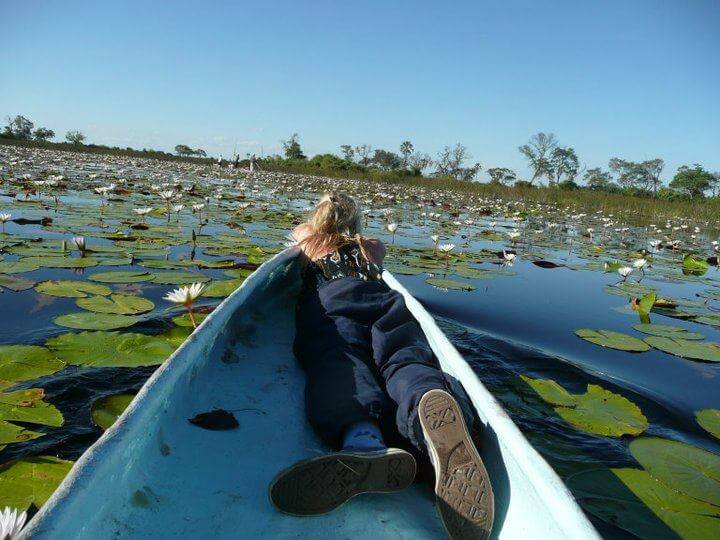
If you’ve ever been poled through the Okavango Delta in a mokoro — the slender dugout canoe that has become almost synonymous with a Botswana safari — you’ve experienced the signature craft of the Bayeyi. Oral history places the Bayeyi’s arrival in the Okavango area a few centuries back, after conflict with other groups pushed them deep into the Delta’s channels, where they encountered the region’s earlier San inhabitants and settled into a way of life built entirely around the water: fishing, harvesting water lily bulbs and other Delta plants, poling seasonal hippo and fishing expeditions, and — eventually — becoming the backbone of the modern mokoro-poling trade that now underpins much of Delta tourism.
Traditional Bayeyi material culture leans heavily on the Delta’s raw materials: finely woven baskets, reed mats, and leather work that draws on cattle and wild game alike. Today the great majority of mokoro polers working out of Maun, the Delta’s Panhandle villages, and Moremi’s community concessions are Bayeyi, for whom the skill of reading water depth, channel direction, and hippo movement by pole alone is both an inherited craft and, increasingly, a genuine tourism livelihood.
Visiting respectfully
A mokoro excursion is the obvious and most direct way to meet Bayeyi culture, and it’s worth asking your operator specifically whether your poler is Bayeyi and whether the mokoro station or community campsite you’re using channels a share of proceeds back into the local village trust — several of the community-run sites around Boro, Ditshiping, and the Delta’s eastern panhandle operate exactly this way. Beyond the water itself, a stop at a roadside basket stall around Maun or Shorobe is a good, low-key way to buy directly from Bayeyi weavers rather than through a curio-shop reseller further down the chain.
4. The Hambukushu (Mbukushu) — the Panhandle’s farmers, carvers, and weavers
Along the Okavango Panhandle — the narrower, more northerly stretch of the Delta around Etsha, Gumare, and Shakawe — live the Hambukushu, a Bantu-speaking farming and fishing people whose roots trace back toward the Zambezi and Kavango river systems before waves of regional conflict, including with Lozi and Ndebele forces in the 18th and 19th centuries, pushed successive groups of Hambukushu south into what’s now Botswana; the Etsha villages themselves were founded by Hambukushu refugees who crossed from Angola as recently as the 1960s, during Angola’s independence-era upheaval.
The Hambukushu share close cultural and linguistic ties with the Kavango peoples of neighbouring Namibia — unsurprising, given how thoroughly colonial-era borders cut across pre-existing river communities in this corner of Southern Africa. Traditional Hambukushu life combines flood-recession farming on the Delta’s fertile plains with fishing and, historically, ironworking; today the group is particularly known for finely coiled basketry, made from the same real fan palm leaves used by Bayeyi weavers, and for wood carving traditions that echo those of Kavango artisans across the Namibian border.
Visiting respectfully
Etsha 6, Etsha 13, and the surrounding Panhandle villages are the best entry points, and several community trusts in this area sell baskets and carvings directly, with proceeds supporting the weavers themselves rather than a distant retailer. If your route runs the Panhandle en route toward Tsodilo Hills or the Namibian border crossing at Mohembo, it’s worth building in time for a stop at one of these roadside stalls rather than treating the drive as a pure transit leg.
5. The Basubiya and the Chobe/Zambezi-region peoples
At Botswana’s far northeastern tip, where the Chobe River meets the Zambezi near Kasane, the country’s culture shifts noticeably — away from the cattle-and-kgotla world of the south and toward the river-based communities more typical of the wider Zambezi basin. The Basubiya (also Subiya or Masubia) are the most prominent of these groups on the Botswana side of the border, sharing close kinship, language, and cultural ties with Subiya communities across the river in Namibia’s Zambezi Region and Zambia — a legacy, again, of colonial borders drawn straight through pre-existing river-based kinship networks.
Traditional Basubiya life centres on fishing the Chobe and Zambezi’s waters, cultivating the fertile floodplains once seasonal flooding recedes, and cattle and goat herding on the surrounding higher ground — a mixed river economy broadly similar to that practised by Namibia’s Zambezi peoples just across the water.
Visiting respectfully
Kasane, the main town of Botswana’s northeastern corner and gateway to Chobe National Park, is where most travellers will pass through this region, typically en route between Victoria Falls, the Okavango, and Namibia’s Zambezi Region. It’s a region best appreciated at a slower pace if your itinerary allows it — river villages and small fishing communities along the Chobe waterfront offer a genuine, low-pressure glimpse of Zambezi-basin river culture without requiring a dedicated cultural tour.
6. The Herero (Ovaherero) — cattle herders with roots in tragedy
A smaller but visually distinctive presence in Botswana’s Ghanzi District and parts of Ngamiland, the Herero share their origin story with Namibia’s much larger Herero population: pastoralists whose ancestral lands lay in what’s now central Namibia, until German colonial forces killed an estimated 80% of the Herero population between 1904 and 1908 in a campaign the German government formally acknowledged as genocide in 2021. Facing that violence, groups of Herero fled east across the Kalahari into British-administered Bechuanaland — today’s Botswana — where their descendants have lived for well over a century.
As in Namibia, Herero identity in Botswana remains closely tied to cattle — herd size and quality still carry deep social significance — and Herero women’s traditional dress, with its distinctive full-length gown and horn-shaped headdress echoing cattle horns, remains a proud and visible marker of identity at weddings, funerals, and community gatherings in Ghanzi and the surrounding farming districts.
Visiting respectfully
Herero communities in Botswana are considerably more dispersed and less served by dedicated cultural tourism infrastructure than their counterparts in Namibia’s Kunene region, so a respectful encounter here tends to be incidental rather than programmed — a market day in Ghanzi, a wedding or community gathering you may be invited to observe rather than one you can book. If you do encounter Herero communities in traditional dress, treat it with the same respect due any significant cultural or family occasion, and always ask before photographing.
7. The Bakgalagadi — the Kalahari’s other Tswana-related people
Occupying something of a middle position between Botswana’s Bantu-speaking majority and its San communities, the Bakgalagadi are a Tswana-related people who moved into the southern and western Kalahari region generations before the main Tswana chiefdoms arrived, and who subsequently developed close, complex, and at times unequal relationships with the San communities already living in the desert around them. Linguistically closer to Tswana than to any San click language, Bakgalagadi communities historically combined small-stock herding — goats especially, better suited to the arid Kalahari than cattle — with gathering and some hunting, adapting Tswana-style pastoralism to one of the harshest environments in Southern Africa.
Today Bakgalagadi communities are concentrated mainly in the Kgalagadi and Ghanzi Districts, including within and around the Central Kalahari Game Reserve, where Bakgalagadi families have, alongside San communities, been affected by the same government resettlement policies discussed in the San section below.
Visiting respectfully
There’s no dedicated Bakgalagadi cultural tourism circuit as such, and the respectful approach mirrors the one for Namibia’s smaller, less-visited groups: an aware one. If your route passes through the Kgalagadi District or the settlements around the Central Kalahari, it’s worth knowing that the desert towns and cattle posts you pass are home to a distinct people with their own long history in this landscape, not simply an extension of the Tswana south.
Part Two: The Khoisan Peoples — Botswana’s Original Inhabitants
Long before any Bantu-speaking group reached what’s now Botswana, the Kalahari was home to the San — hunter-gatherer communities whose presence in the region stretches back tens of thousands of years, making them, by most archaeological and genetic accounts, the oldest continuous culture in Southern Africa. Known officially in Botswana as Basarwa, and historically (now largely outdated and best avoided) as “Bushmen,” the San aren’t one people but a constellation of distinct groups speaking different, though related, click languages — the Naro of the Ghanzi area, the Ju/’hoansi near the Namibian border, the G/wi and G//ana of the Central Kalahari, and several smaller groups including the Khwe, Tsua, and ǂHoan, among others.
8. The San (Basarwa) — the Kalahari’s first people, and a difficult modern history
Traditional San life was built around an extraordinary depth of environmental knowledge: tracking skills precise enough to follow an animal’s trail across kilometres of seemingly featureless terrain, detailed knowledge of which of the Kalahari’s plants provide food, water, medicine, or poison for hunting, and small, mobile family bands rather than fixed settlements — a way of life remarkably well adapted to one of the driest, least hospitable environments on the continent.
That traditional lifestyle has been dramatically disrupted over the past several decades, and it’s worth understanding the outline of why before you travel, because it shapes how San communities today relate to both the Botswana government and to tourism itself. The Central Kalahari Game Reserve (CKGR) — one of the largest protected areas in the world, and larger than the Netherlands — was originally established in 1961 partly to safeguard San communities’ traditional way of life within its boundaries. Beginning in the 1980s and accelerating through the 1990s and early 2000s, however, the Botswana government pursued a policy of relocating CKGR residents to settlements outside the reserve, officially framed as improving access to services such as schools, clinics, and water. San organisations, led by the advocacy group First People of the Kalahari, argued the relocations were instead intended to clear the way for diamond prospecting and safari tourism, and the process involved documented confrontations, including incidents where residents were removed by force. In 2006, Botswana’s High Court ruled the evictions unlawful and unconstitutional and affirmed residents’ right to return; in practice, access to the reserve — including water infrastructure and hunting rights — has remained heavily restricted and contested in the years since, and the underlying land and resource dispute continues today. It’s a genuinely difficult, still-unresolved chapter, and one that any honest guide to Botswana’s peoples has to acknowledge rather than smooth over.
None of that erases the fact that San culture in Botswana today is a living, adapting one, not solely a story of loss. A number of San-led community organisations — most notably the Kuru Family of Organisations, based in D’Kar near Ghanzi — have spent decades building genuinely community-owned models for cultural preservation, education, and tourism that put decision-making and revenue directly in San hands.
Visiting respectfully
Dqãe Qare Game Reserve, a 7,500-hectare community-owned farm just outside Ghanzi run by the San community of D’Kar, is one of the most genuinely community-controlled cultural tourism experiences in the country — visitors can join guided bush walks, traditional fire-making and jewellery demonstrations, and dance performances led by D’Kar residents themselves, with proceeds supporting the community directly through the D’Kar Trust. If your timing allows, the annual Kuru Dance Festival, held at Dqãe Qare (usually around August), draws San performers and communities from across Botswana, Namibia, and South Africa for several days of dance, music, and craft — a considerably larger and more genuinely community-driven event than a standard lodge cultural show. Further north, San guides working out of Khwai, on the edge of Moremi Game Reserve, offer another respectful entry point, with a community trust that channels tourism income from bush walks and cultural demonstrations back into the village.
As with any cultural visit of this kind: always ask before photographing, expect that some community members will decline, and treat demonstrations of tracking, fire-making, or plant knowledge as genuine skill-sharing rather than a performance staged purely for visitors. Given the history above, it’s also worth being thoughtful about language — “Basarwa” or naming the specific group (Naro, Ju/’hoansi, G/wi) where you know it is generally preferable to the older, now widely considered outdated term “Bushmen,” though usage varies and it’s reasonable to follow the lead of the community and guide you’re actually with.
Part Three: Smaller Communities
9. White and Indian Batswana
A small but economically significant White Batswana community — descended mainly from Afrikaner farming families who arrived from South Africa in the 19th and 20th centuries, alongside smaller numbers of British-descended residents — is concentrated in Gaborone, Francistown, Ghanzi’s farming district, and other urban centres, where the community has historically been prominent in commercial farming and business. A similarly small but visible Indian Batswana community, tracing its roots to traders and merchants who arrived from South Asia during the colonial and early post-independence periods, plays a notable role in retail and commerce in Gaborone and Francistown today.
Visiting respectfully
As with Namibia’s White and Coloured communities, this is a group you’ll encounter through everyday interaction — in guesthouses, farm stays around Ghanzi, and shops and restaurants in Botswana’s towns — rather than through any dedicated cultural visit, and the respectful approach is simply the one that applies to travel generally.
Visiting Botswana’s Living Cultures: A Responsible Traveller’s Primer
A few principles carry across every community in this guide, worth keeping in mind regardless of which group you meet:
Choose community-owned or community-trust-run experiences wherever they exist. Botswana’s community-based natural resource management (CBNRM) model — used at Dqãe Qare, Khwai, and a number of Panhandle and Delta trusts — is genuinely one of the more community-controlled tourism structures on the continent when it works as intended. Seek it out over a generic “village visit” bolted onto a lodge itinerary.
A guide’s relationship to the community matters as much as the destination itself. Ask directly: is your poler, tracker, or cultural guide from this community, or does the operator have a real, ongoing partnership with it?
Always ask before photographing people, and accept “no” without pushing — this applies doubly to children.
Buy crafts directly from the people who made them where you can — a basket bought at a roadside stall near Etsha or Shorobe, or a carving from a D’Kar craft outlet, puts far more of what you spend into the maker’s hands than a curio shop resale does.
Understand that Botswana’s national “we are all Batswana” ethos, while genuinely a source of the country’s remarkable stability, has also at times meant less official recognition or protection for the identities and land claims of smaller groups — the San most visibly. Being aware of that tension doesn’t require taking a side on the ground; it just means travelling with a slightly clearer picture of what you’re seeing.
Remember these are contemporary communities, not exhibits. The traditions you’ve come to see — a mokoro pole cut and shaped the traditional way, a rainmaking ritual, a San tracking demonstration — are how these particular families and communities currently choose to live and work, not a performance staged solely for visitors.