



Explore Uganda
57 days
South Africa
Places you'll visit
African Overland Tours
https://www.facebook.com/AfricanOverlandTourscom/
https://www.instagram.com/african_overland_tours/
https://www.youtube.com/@africanoverlandtoursandsafaris
+27 (0) 21 448 0997
Customer Service
Worldwide


Imagine spotting the most impressive predators of East and Southern Africa while touring the stunning landscapes of the golden savannah. It is the highlight of any tour and an experience few forget! But do you know whether what you’ve seen is one of South Africa’s Big Five or just its look-alike? With their spotted coats and powerful presence causing moments of delightful confusion, we explore key differences, helping you expertly spot the difference between these two animals on tour!
The sight of a large, spotted cat on tour is most exciting. But distinguishing between these apex predators can be trickier than you think. While they share similarities in their beautiful spotted coats, similar build, and speed, they are incredibly different creatures with unique traits which are tailored to adapt to their environment.
Leopards have clusters of black or tanned spots that often have a dark outline and lighter center, forming circular or varying shapes across their bodies. The spots on the Cheetah can sometimes appear as smudged black spots, often round or oval in shape. Their fur features a mix of small and large spots, whereas the Leopard features smaller black spots along their face, snout and legs only. The colour of their fur is another way to distinguish them. While both blend in well with the tannish colours of African nature, Leopards tend to have more yellowish fur, with Cheetahs having tawny coloured fur. An easier way to distinguish between the two is to look at their faces. Cheetahs have black “tear marks” running from the inner corner of the eyes along the sides of their nose to their mouths. Experts believe it helps them when hunting during daytime, reducing the sun’s glare. Leopards lack these tear marks but have a stronger jaw than Cheetahs. While their bodies may look the same, their body shape and build can offer significant clues to which wild cat you are seeing. Leopards show great strength and climbing ability, have shorter legs, a larger head and are more muscular and sturdier than Cheetahs. Their fully retractable claws make it easier for Leopards to climb trees and grip onto prey. The roundness of their tails provide balance when climbing and walking through nature.
Cheetahs have thinner longer legs, a smaller rounder head and a deeper chest than Leopards. Their lightweight, slender, aerodynamic body is the perfect build for speed, making them the fastest land animal in the world. To help the Cheetah in its speed, its semi-retractable claws aid in providing better grip and traction when running or chasing prey. Their flatter, rudder-like tails help steer and balance the cheetah at such high speeds – which can sometimes reach 130 km/h! Being the fastest animal on land means relying on incredible speed and agility to hunt down prey. Cheetahs are predominantly diurnal, preferring to hunt in open spaces in the early mornings and late afternoons, avoiding competition with nocturnal predators. They stalk their prey, sometimes tripping or knocking them over before aiming at the neck and going for the kill. As fast as they are, they are not the strongest when defending their kills from other larger animals and will eat as quickly as they can to avoid other animals interrupting them.
Leopards rely on their agility, power and stealth more than they do on speed. They are nocturnal hunters with exceptional night vision. Their muscular build enables them to stalk-and-pounce on their prey, and famously drag their prey into trees to enjoy without interruptions from other predators. If you do get (safely) up close and personal with either of these cats (or if you prefer to gaze at them through binoculars), take a look into their eyes. Cheetahs have amber or light brown eyes, reflecting the golden brown hues of nature, while the eyes of the Leopard sport green and blue, reflecting the African sky and lush vegetation.
East and Southern Africa offer the lushious open spaces of grassland favouring the Cheetahs’ need for speed, and forest, mountainous landscapes for the more adaptable Leopards. If you’re thinking of taking the leap to experience a spectacular adventure, look no further. Our tours in Masai Mara, Serengeti, Namibia, Zambia, Botswana and the Kruger National Park guarantee to make your journey unforgettable! 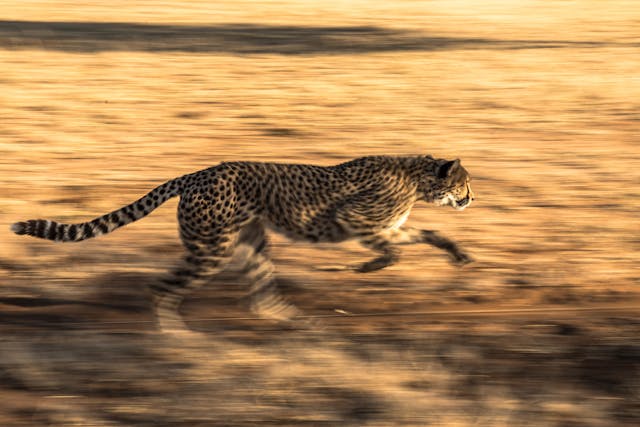
| Feature | Leopard (Panthera pardus) | Cheetah (Acinonyx jubatus) |
| Build | Stocky, muscular, powerful | Slim, lightweight, aerodynamic |
| Size | 60–70 cm at shoulder; 30–90 kg | 70–90 cm at shoulder; 21–72 kg |
| Speed | Up to 58 km/h (36 mph) | Up to 112 km/h (70 mph) – fastest land animal |
| Climbing Ability | Excellent climber; often rests in trees | Rarely climbs trees |
| Hunting Style | Stalk-and-ambush predator | Daytime hunter; sprint-chase predator |
| Claws | Retractable claws | Semi-retractable claws (for traction during sprinting) |
| Facial Markings | Rosette-shaped spots; no tear marks | Solid black spots and distinct black “tear marks” |
| Habitat | Forests, woodlands, savannas, mountains | Open grasslands, savannas |
| Behaviour | Solitary and nocturnal | Mostly solitary; active during the day (diurnal) |
| Vocalizations | Growls, roars, grunts | Chirps, purrs, hisses (does not roar) |
| Distribution | Widespread across sub-Saharan Africa | Scattered populations in Eastern and Southern Africa |
| Conservation Status | Vulnerable (IUCN) | Vulnerable (IUCN), but more threatened in parts of range |
Cheetahs purr like housecats! While they do hiss, growl and chirp, the structure of their vocal chords prevent them from roaring. You can hear a Leopard’s roar from two miles away! Unlike the roar of a Lion, Leopards have a raspy bark, make chuffing sounds and can purr when happy.

ZAR
239355.00https://schema.org/InStock
African Overland Tours
Price From
was
R265,950
R239,355

ZAR
185490.00https://schema.org/InStock
African Overland Tours
Price From
R185,490
"*" indicates required fields