



Explore Uganda
42 days
Etosha National Park
Places you'll visit
African Overland Tours
https://www.facebook.com/AfricanOverlandTourscom/
https://www.instagram.com/african_overland_tours/
https://www.youtube.com/@africanoverlandtoursandsafaris
+27 (0) 21 448 0997
Customer Service
Worldwide

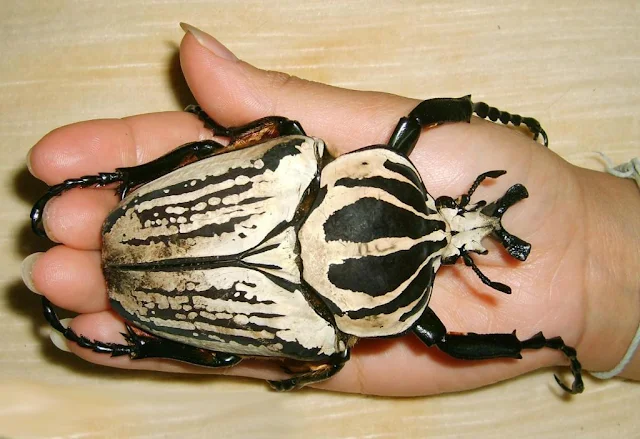
Ever wondered which insect is the largest and the strongest in the world? Get ready for something truly un-beetle-vable as we unpack what makes the Goliath beetle so amazing Among the tall African trees of the rainforest, surrounded by lush foliage and exotic animals, a curious creature stands out with its striking patterns and majestic size. Crawling long tree branches, through the dense undergrowth and sometimes flying about, the Goliath beetle is truly a beautiful and unique insect. Found in the tropical and subtropical rainforests of Botswana, Kenya, South Africa, and Uganda, the Goliath beetle is one of Africa’s many amazing finds.
If you’re not afraid of insects -imagine holding a beetle in the palm of your hand. That is how large a Goliath beetle can grow to be. They reach lengths of up to 11 cm, and typically weigh between 40-80 grams. In their larvae phase they weigh the heaviest, reaching up to 100 grams! Living up to its biblical name, the Goliath beetle is known for its strength to lift objects several times its own weight. Experts estimate it can carry up to 850 times its own weight! Each beetle’s lifting capacity varies slightly based on the beetle’s age, size and individual strength. However, their ability to lift and carry objects that are significantly heavier than itself speaks to its strength and adaptable nature. These usually consists of tree sap and fruits.
The striking exoskeleton of the Goliath beetle features colors of red, brown, black and white. The patterns on them range from spots to strips, to a blank canvas. Males have a Y-shaped horn on their heads to defend themselves against predators (like lizards, frogs, birds and rodents) and to attract a potential mate. In contrast, females have a wedge shaped head used to tunnel. Each beetle has six legs with sharp claws which enable them to climb trees. They have two sets of wings: the outer wings, called elytra, and the inner wings that are used for flying. The elytra help to protect the inner wings when they are spread or when flying. 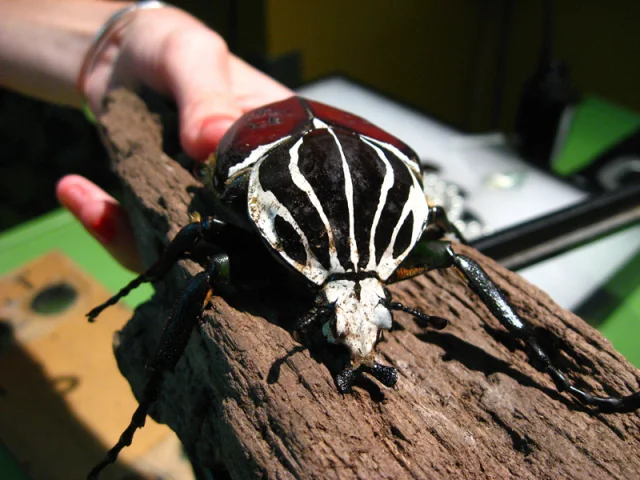
Goliath beetles have a sweet tooth! Their high-sugar diet consists of rotten fruit and tree sap, often fighting butterflies to have a go at the intoxicating goodness (and yes, they do get drunk on it!) Other foods include decaying wood and other insect larvae. When disturbed, the Goliath beetle rubs their wings against their abdomen creating a loud buzzing noise. This process is called stridulation. Male beetles do this to attract female beetles too. Due to their large size, they are known to be noisy fliers too. During the dry season, adult beetles search for potential mates. After mating, female beetles lay their eggs in protein-rich dirt. Sadly, the lifespan of the Goliath beetle is only a few months, with many dying soon after mating. Due to the increased demand for cacao plantations and the growing international dried insect market, these striking insects are, unfortunately, on the road to extinction. The Goliath beetle literally faces death-by-chocolate, as the demand for chocolate worldwide increases and cacao plantations are being wiped out. Illegal animal trade risks catastrophic effects not only on the loss of a species, but the ecosystem as well. In fact, Goliath beetles are indicators of a healthy ecosystem.
| Name & Species | Goliath beetle (Genus: Goliathus) Largest of its species. |
| Habitat & Location | Tropical and subtropical rainforests. Found in Botswana, Kenya, South Africa, and Uganda (Africa). |
| Size & Weight | Adult Length: Up to 11 cm. Adult Weight: Typically 40-80 grams. Larvae Weight: Up to 100 grams (heaviest phase). |
| Strength | Can lift objects up to 850 times its own weight (varies by individual). |
| Physical features | Exoskeleton: Striking patterns with colors of red, brown, black, and white. Males: Y-shaped horn on head (defence, attracting mates). Females: Wedge-shaped head (tunnelling). Legs: Six legs with sharp claws (for climbing trees). Wings: Two sets: Outer wings (elytra – protective) and inner wings (for flying). |
| Diet | High-sugar diet: Rotten fruit, tree sap. Also eats: Decaying wood, other insect larvae. |

ZAR
172440.00https://schema.org/InStock
African Overland Tours
Price From
was
R191,600
R172,440
ZAR
134199.00https://schema.org/InStock
African Overland Tours
Price From
R134,199

ZAR
51500.00https://schema.org/InStock
African Overland Tours
Price From
R51,500

"*" indicates required fields