Etosha is one of the more affordable of Africa’s great safari destinations, and it’s also one of the easiest to visit cheaply without compromising on the quality of the experience — which isn’t something you can say about every park in this guide series.
The main costs involved in an Etosha safari are the park’s entrance and vehicle fees, accommodation, transport and fuel, and an optional guide or tour operator fee. I discuss these different costs to help you understand which ones are outside of your control and which ones you can keep low, and how. If you read to the end, you’ll know how to visit Etosha on a budget and also calculate a personal trip price tag.
Let’s first look at the park’s fees, and then at the other costs that are more within your control.
The unavoidable expense: Etosha’s park fees
Etosha falls under a single national authority — Namibia’s Ministry of Environment, Forestry and Tourism (MEFT) sets and collects entrance and conservation fees, while the parastatal Namibia Wildlife Resorts (NWR) manages the rest camps inside the park. That’s a considerably simpler system than somewhere like the Masai Mara, which splits across multiple management bodies and a ring of separately-charging private conservancies — in Etosha, one fee schedule covers the whole park.
If you don’t wish to deal with the calculations explained below, consider travelling with a tour operator, who will include the tariffs in their package price and arrange payment on your behalf. That said, Etosha is genuinely one of the more manageable parks to handle independently — more on that below.
List of Etosha fees
Namibia significantly revised its national park fee schedule effective 1 April 2026, and Etosha — classified as a “premium park” alongside Namib-Naukluft, Skeleton Coast, and Waterberg Plateau — saw one of the larger increases. Fees below reflect the current schedule, though as with any government-set tariff, it’s worth double-checking closer to your travel dates.
1. Entrance fee
International (non-SADC) adults pay NAD 280 per day (made up of a NAD 140 entrance fee plus a NAD 140 conservation levy) — up from NAD 150 before the April 2026 revision. SADC nationals pay NAD 180 per day, and Namibian citizens pay NAD 60. Children aged 8 to under 16 pay NAD 180 (international) or NAD 100 (SADC); children under 8 enter free regardless of nationality. Fees are valid for a 24-hour period from the time of entry — a straightforward cycle, unlike the Masai Mara’s stricter 12-hour, single-calendar-day rule.
Unlike Serengeti or the Masai Mara, Etosha’s entrance fee does not fluctuate by season — you’ll pay the same rate whether you visit in the busy dry-season months or the quieter wet season. That changes the budget-planning calculus somewhat, which I’ll come back to below.
Proof of identification — a passport for international visitors, or a Namibian ID or driver’s licence for locals — is required at the gate, partly as an anti-poaching measure.
The Namibian Dollar is pegged 1:1 with the ZAR, and South African Rand notes are legally accepted everywhere in Namibia (though change is usually given in NAD). For budget travelers and overlanders combining South Africa and Namibia, this makes cash management incredibly simple.
2. Vehicle fee
Vehicles are charged separately from passengers: NAD 60 per day for vehicles with up to 10 seats, NAD 150 for 11–25 seats, NAD 600 for 26–50 seats, and NAD 1,000 for 51 or more seats. For a typical self-drive visit — two international adults in a standard rental vehicle — the daily park cost (entrance plus vehicle fee) now comes to roughly NAD 620, up from about NAD 350 under the old schedule.
3. Camping or accommodation fee
This is where Etosha offers a genuinely excellent budget option most other major African parks can’t match: NWR operates rest camps inside the park itself — Okaukuejo, Namutoni, Halali, Dolomite, and Olifantsrus — with camping options considerably cheaper than any lodge, inside or outside the park boundary. Camping fees at NWR sites are charged per person per night on top of the daily park entrance fee, and represent by far the most affordable way to base yourself inside Etosha.
4. Guided activities
Since driving after dark is not permitted for private vehicles inside the park (all gates close at sunset, and you must be at your camp before then), the only way to experience Etosha’s famously good nocturnal wildlife activity from a vehicle is via an NWR-guided night drive, booked and paid for separately at the camp reception. These aren’t compulsory, though, for reasons covered below.
Three final notes on Etosha’s rules, worth restating specifically: gates operate from sunrise to sunset (times shift monthly, roughly 6:00–7:30am opening and 5:30–7:30pm closing), you must reach your destination camp’s gate before it closes, and fees are non-refundable once paid.
5. Food & Fuel: The Ultimate Budget Hack (Self-Catering vs. Group Safari)
Eating at NWR camp restaurants every single night will quickly destroy a tight budget, and the food quality across the park’s main hubs can be hit-or-miss. Fortunately, every single NWR campsite features a built-in braai (BBQ) stand, making self-catering an incredibly popular and affordable way to eat.
If you are managing your own meals, do not rely on the park’s tiny camp kiosks—their selection is sparse, and prices are heavily marked up. Instead, stock up heavily on groceries, fresh meat, and firewood at the large supermarkets in Outjo (if you are entering via the southern Anderson Gate) or Tsumeb (if you are entering via the eastern Von Lindequist Gate).
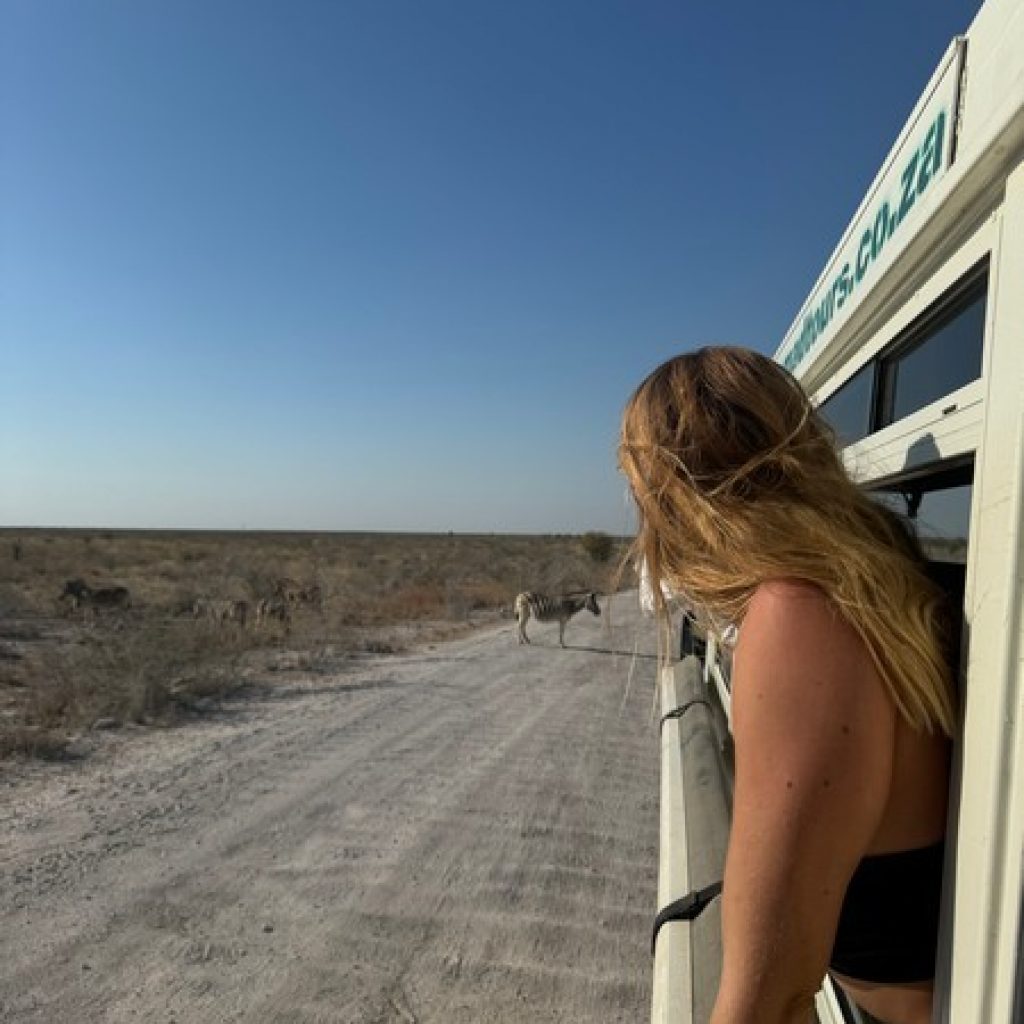
How to plan a budget Etosha safari
Let’s now look at the costs that are more malleable, to see how you can bring down the price tag of an Etosha safari.
Note: Etosha sits roughly 400–450km north of Windhoek by road (around a 4.5–5.5 hour drive depending on which gate you’re aiming for), making it an easy, well-signposted self-drive destination if you’re arriving with a rental vehicle from the capital.
1. Choose budget accommodation — and stay inside the park
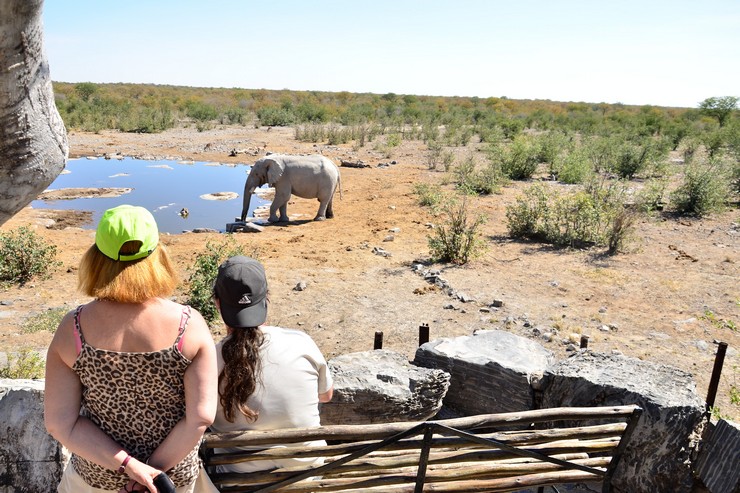
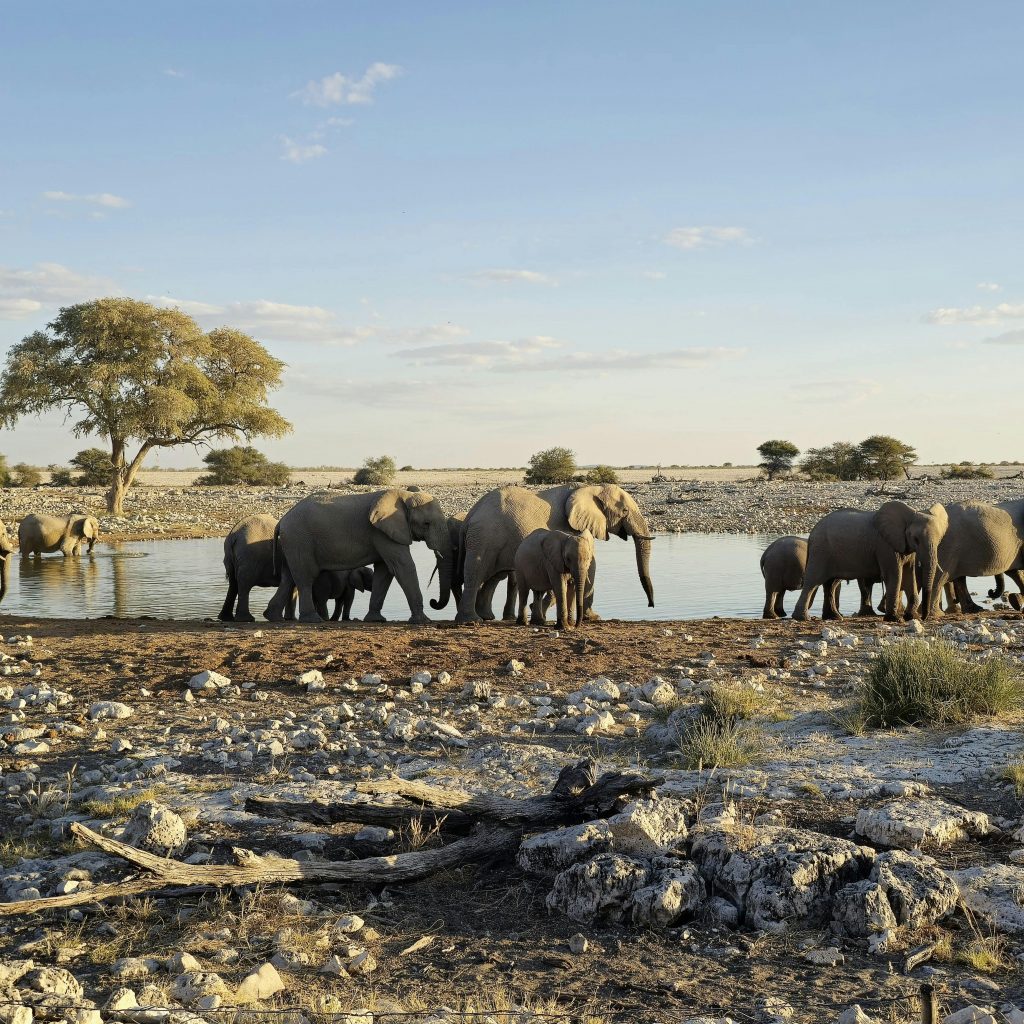
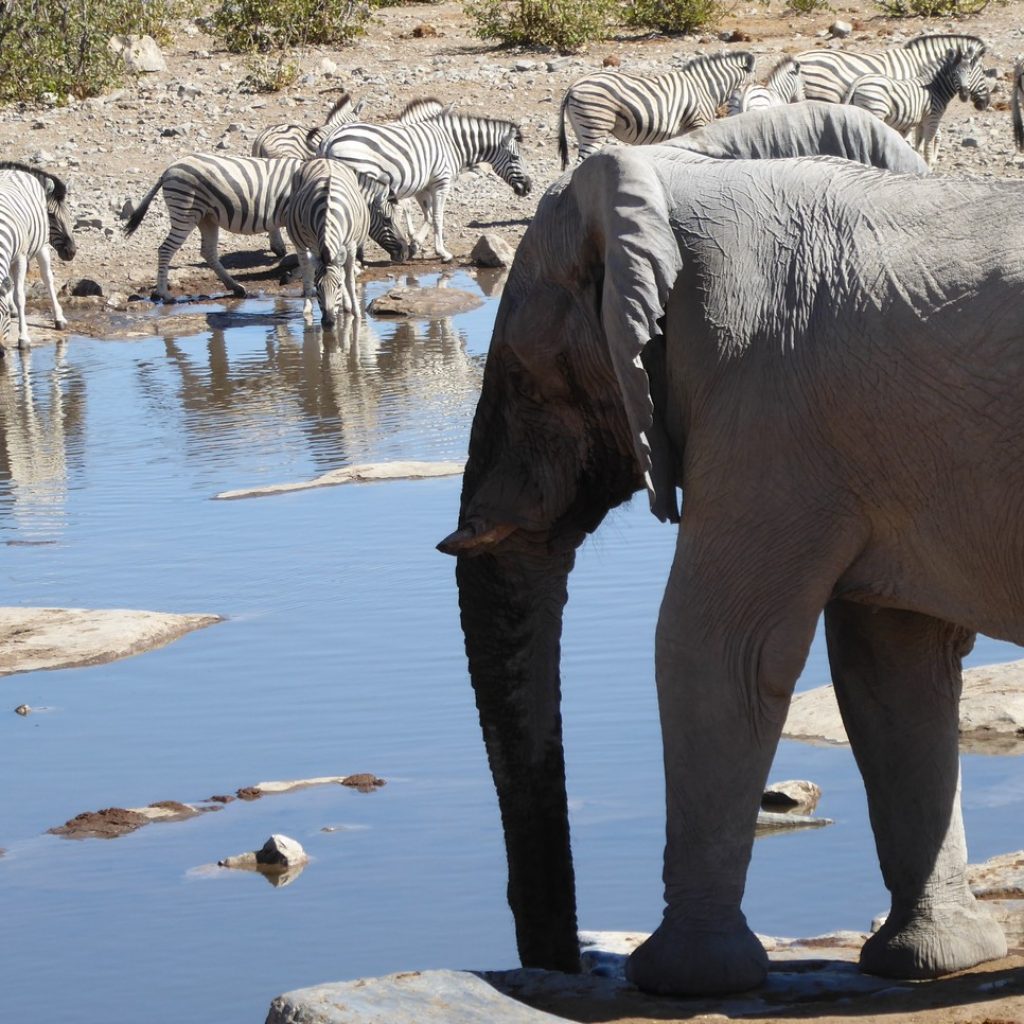
Unusually for a major safari park, staying inside Etosha at an NWR rest camp can actually work out more affordable, not less, than staying at a private lodge outside the boundary — and it comes with a genuine perk private lodges outside can’t fully replicate: each NWR camp is built around its own floodlit waterhole, where you can sit for free in the evening and watch elephant, rhino, and lion come to drink, often better wildlife viewing than an actual paid game drive delivers. Okaukuejo’s waterhole in particular has a strong reputation for reliable black rhino sightings after dark.
Camping at these rest camps is the cheapest way to experience Etosha properly; private lodges just outside the park’s eastern and southern boundaries (around the Von Lindequist and Anderson gates) tend to sit at a noticeably higher price point, trading the in-park waterhole access for a more upmarket setting.
2. Join a budget small-group safari rather than going completely alone
While Etosha is famously one of the easiest parks in Africa to self-drive—thanks to its flat terrain and well-graded main roads—attempting to navigate its massive expanses entirely on your own isn’t always the budget victory it seems. The park’s fierce limestone gravel is notorious for shredding standard rental tires, and spending your safari staring intently at the corrugated road means you are inevitably missing the leopard camouflaged in the mopane trees or the rhino tucked into the bush.
For the smartest budget-conscious traveler, joining a small-group safari with a specialist operator like African Overland Tours delivers the ultimate sweet spot. By sharing the cost of the vehicle, fuel, and an expert local guide across a small group, you keep your personal expenses remarkably low—often rivaling or beating the hidden costs of a solo vehicle rental, steep tire insurance, and fuel.
Best of all, you get to sit back in a custom-built elevated vehicle (offering a much better game-viewing vantage point than a cramped rental sedan) while a professional guide uses their network and deep local knowledge to track down Etosha’s famous Big Five. It completely eliminates the stress of reaching the rest camp gates before the strict sunset lockdown, leaving you free to simply enjoy the journey.
Explore these affordable Etosha safaris to find a small-group itinerary that fits your budget perfectly!
Nature & Wildlife, Wilderness Walks, Mountain Adventures, Cultural Immersion, Desert Adventurer
Nature & Wildlife, Wilderness Walks, Mountain Adventures, Cultural Immersion, Desert Adventurer
Nature & Wildlife, Wilderness Walks, Cultural Immersion, Desert Adventurer
Nature & Wildlife, Wilderness Walks, Cultural Immersion, Big 5 Safari, Dramatic Vistas
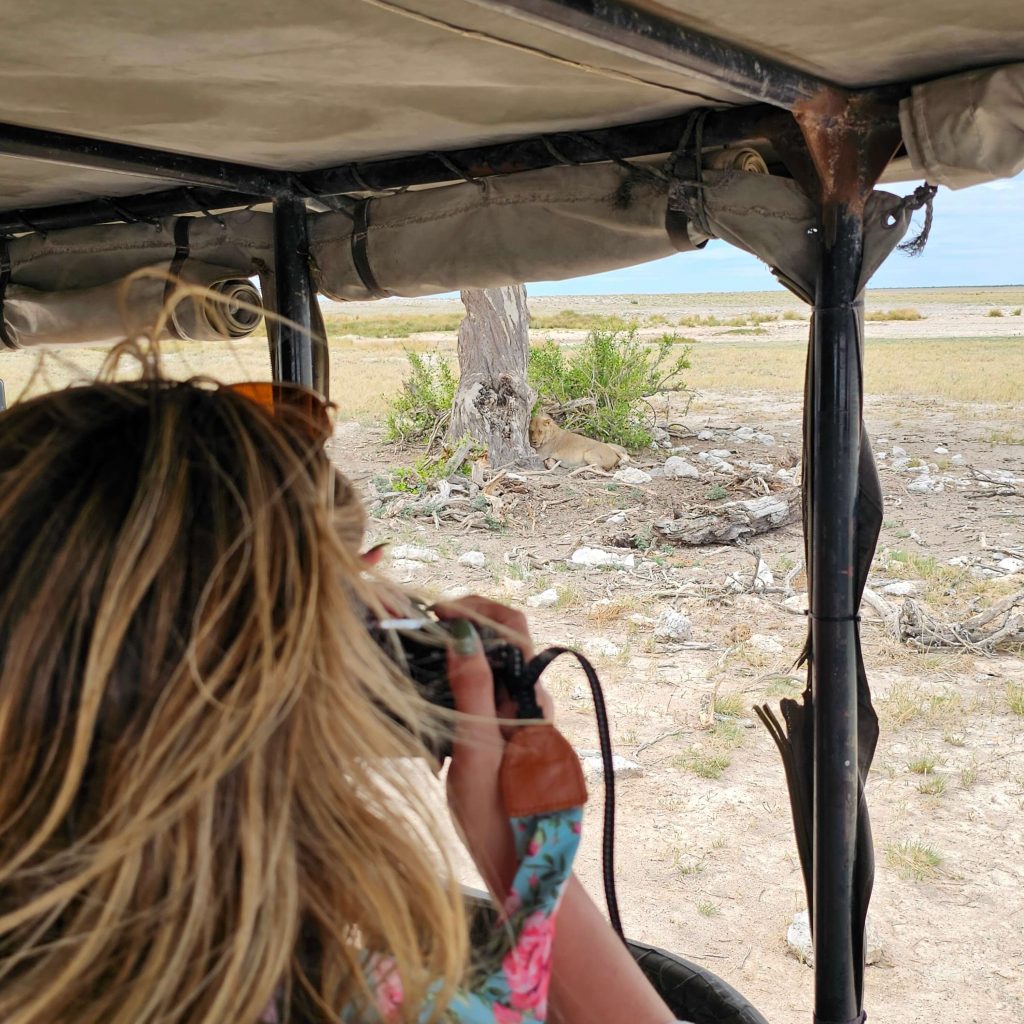
3. Make the most of your camp’s waterhole
Since Etosha’s entrance fee already covers a full 24 hours regardless of what you do with it, the floodlit waterholes at Okaukuejo, Namutoni, and Halali are effectively a free, built-in game-viewing activity every single evening of your stay. Bring a chair, arrive after dinner, and you’ll often see more concentrated wildlife activity in an hour at the waterhole than in an entire afternoon’s drive — without spending a single extra dollar on a game drive to get it.
Pro-Tip: Master the NWR Waterhole Etiquette
While sitting at the Okaukuejo or Halali floodlit waterholes is completely free, remember that wildlife has incredible hearing. The waterholes have strict “silence zones.” Bring a warm jacket (Namibian winter nights get down to single digits celsius), a flask of hot tea or a sundowner, and keep your voice to a whisper so you don’t spook the black rhinos.
The Strict No-Go’s
Like most major African reserves, drones are strictly illegal in Etosha as an anti-poaching measure. Additionally, you cannot bring raw poultry or meat out of certain northern veterinary cordon lines (the “Red Line”) due to foot-and-mouth disease controls—though taking it into Etosha from the south is generally perfectly fine.
4. Time your visit around value, not fees
Because Etosha’s entrance fee doesn’t change by season (unlike Serengeti or the Masai Mara, where visiting in the “wrong” months can double your daily rate), timing your trip is really about balancing accommodation cost and crowd levels against sighting quality rather than dodging a fee hike.
The dry season (roughly June to October) delivers the best game viewing, as the park’s sparse permanent water sources concentrate wildlife predictably around waterholes — but it’s also when accommodation demand, and prices, are highest.
The wet season (November to April) brings lower accommodation rates and thinner crowds, at the cost of wildlife being more dispersed across a greener, better-watered landscape. If keeping accommodation costs down matters more to you than maximising sightings, the wet season is the more budget-friendly window; if concentrated game viewing is the priority, dry season is worth paying a bit more for.
Explore these budget Etosha safaris on offer by African Overland Tours to see what’s on offer!