






Other information
Pre-Departure Meeting
- Pre-departure meetings are usually held the evening before the tour starts.
- Most overland tours begin in Nairobi, Kampala, Dar es salaam, Livingstone, Victoria Falls, Windhoek, Swakopmund, Cape Town or Johannesburg and held on the evening prior to the safari departure date at 6pm.
Zanzibar Excursion
- If Zanzibar is included in your tour, you will enjoy an excursion to the Zanzibar Island which includes a ferry ride for about approximately 2 hours
- The overland vehicle remains in Dar es salaam while you explore the island.
- Your accommodation on the island is included on the Adventure Pass, but not the meals (Lunch and Dinner)
- More information on the tour will be given while on tour
- You will only need a backpack for your excursion to the island (Your main back pack will be left at the truck).
- A list of items to pack for your excursion are the following:
- Passport (the island considers itself ‘apart’ and you must carry your passport when entering and leaving)
- Yellow Fever Certificate (Compulsory!)
- Change of clothes in your day pack, swimsuit, sun screen, hat, small first aid kit and towel, anti-malarials
- Money : * US$ 10 – $25 per day (other meals)
- US$ 75 – 150 (drinks, curious, local tours, etc)
Important Touring Tips:
- The itinerary is a guide ONLY and is subject to change
- There is a mix of different nationalities, ages and cultures on every tour
- Space in the truck is limited – PLEASE DON’T BRING TOO MUCH LUGGAGE!
- The tours are high adventure tours, so don’t expect European Coach tours or lodge safaris
- The tours are often created in a circular route i.e. where one tour ends, another begins
- The rate is the same throughout the year
- All meals are served from the truck unless specified otherwise
- Should you be travelling to Kenya. The Kenya government has instituted a Zero Tolerance on usage of All Plastic Bags. On the spot fines (400 USD) are being issued.
What are adventure tours?
These are adventure tours perfect for people who enjoy camping and the outdoors. You get to experience the “real Africa” by camping out at night, sitting around the campfire, taking in beautiful scenery, visiting local shops and getting to know the locals.
What is a typical day?
A typical day on either your camping or accommodated Africa overland tour starts with an early morning wake-up call and a cup of tea or coffee followed by breakfast. Campers pack-up their campsite while comfort travellers check-out of their accommodation and hit the road.
We set off to our next destination travelling through a vast variety of landscapes, making our own new memories with new friends. Each day in Africa offers a new experience from an early morning sunrise hike, quad biking, sky dive or guided nature walk. The options are endless!
We have shorter travel days arriving at our campsite by midday or early afternoon, to enjoy lunch before joining our afternoon activity or simply enjoying a relaxed afternoon at your own pace.
On our longer travel days an early start ensures an earlier arrival at our campsite. We stop off at scenic spots to stretch our legs and take in the scenery, before lunch is enjoyed at a shady spot en-route. A mid- to-late afternoon arrival at our campsite allows us to set up camp, enjoy a beautiful sunset and end the day sitting around the campfire, under the stars.
Our best advice: expect the unexpected as this is Africa! We travel mainly on gravel roads and poorly kept tarmac roads – both setting the pace at which we travel. We do our best to arrive at our next destination, safety is our number one priority and while our overland vehicles are comfortable and spacious, they are not sports cars!
What type of vehicles do we use?
- A custom-built, comfortable, safe and self-sufficient Africa overland truck to withstand the rugged African terrain.
- Various vehicles are used on varying tours, with each offering comfortable seats with ample leg room.
- Each vehicle has large glass windows for uninterrupted views and perfect for game drives.
- Smaller 4×4 land cruiser type vehicles are used for game viewing in the Serengeti and Ngorongoro Crater, due to the roads being tougher and too narrow for the overland trucks.
- Each overland vehicle includes a passenger safe to safely keep money + passports + flight tickets + credit cards. The keys are kept with your Tour Leader who will advise of safety requirements in place concerning the safe.Who is suited to go on an adventure tour?
- Almost anyone can go on an adventure.
- Some level of fitness is required due to accessing the vehicle and spending long days on bumpy roads (can take it out of you).
EAST AFRICA TOURS require a more adventurous, fearless attitude and are suited to a younger traveller.
If you are planning to trek with the Mountain Gorillas or climbing Mount Killi you will need to have a higher fitness level.
WHAT TO EXPECT ON A CAMPING OR ACCOMMODATED TOUR
Camping Tours:
A camping safari is for travellers who want a hands-on experience of Mother Nature. The guide(s) will do most of the work, but you will be required to assist with various tasks such as preparing the food, washing up, cleaning out the truck and setting up the campsite and your tent. If you dream of a lifetime African adventure, embark on a journey with us sleeping under the stars while listening to the sounds of wildlife in the distance.
We offer camping safaris suited to travellers who may prefer to travel in a younger group (aged 18 to 39). Or, you can choose a mixed age group (18 to 60). A camping safari must not be underestimated and will require active participation which means good health and a fair degree of fitness. We have a tour to suit what you have in mind, so please do not hesitate to enquire with us.
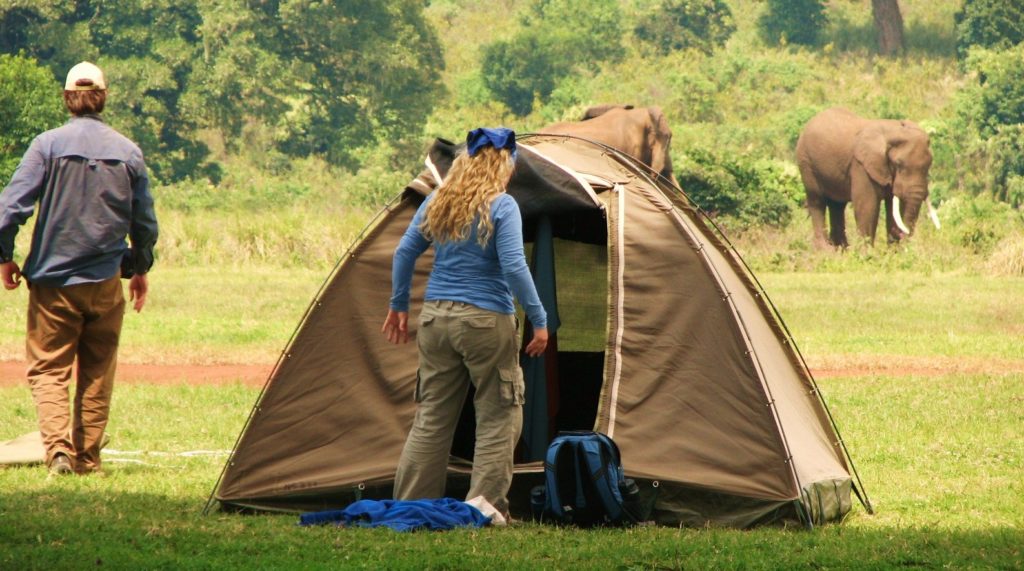
During an African camping safari you will stay in large two-man dome canvas tents which are spacious enough for two adults and your luggage. Or, you can opt to have your own tent by including the single supplement (valid on select camping tours).
Your tents are put up and taken down easily – your Tour Leader will show you exactly how to do this and help out when you are unsure. All tents are well-ventilated by means of a tent-door and window, covered with mosquito net. They also include a fly-sheet for the rain.
Most camping safaris include a sleeping mat (please do check with us upon enquiry). You need to bring your own sleeping bag, pillow and towel. All meals are prepared at the truck and you will be required to assist with the preparation.
The African campsites are basic and comfortable and you will be able to upgrade your accommodation at most of the places, but this is subject to availability. Most have warm showers and flushing ablutions, while others may have natural ablutions. Some places visited are bush camps where there are no facilities.
Accommodated Tours:
Accommodated safaris are ideal for travellers who prefer to experience African wildlife and adventure with extra comforts. You are surrounded by vast landscapes and wildlife, curiously roaming at your door-step. It is comfort, without the price tag!
Our accommodated safaris make use of a combination of lodges, hostels, bungalows, chalets, permanent safari camps, hotels and traditional huts. Our properties are ideally located at each destination for an authentic experience with incredible views.
We book Twin rooms if you are travelling with a partner or friend and Single rooms for single travellers (including single supplement). Most of the time we stay in 1-3 star properties with en-suite bathrooms in Southern Africa. In Eastern Africa we offer a combination of en-suite and shared bathrooms. In the case of shared bathrooms, you will be sharing with friends on your tour. Please bring your own towels as these are not always provided.
Select accommodated safaris include a camp assistant to help out with the smaller aspects of your vacation.
The standard of the properties varies along the trip. The Southern Africa properties are much more established than the East Africa accommodation. They vary from basic (but comfortable) to lovely properties. Due to the remote nature of the trips, accommodation choices are limited.
Distances and Road Conditions:
Our tours cover long distances so you can see significant amounts of Africa this means that there will be long days spent on the road often with nothing to look at except vast open plains. You can spend between 350km and 650km a day in the truck so it is important to be prepared.
What will you eat on safari?
Our Africa overland vehicles are fully stocked with dry goods at the start of each tour. We buy fresh produce (fruit and vegetables) almost daily to ensure fresh, good quality and tasty meals. Over the summer months fresh produce is not always available due to the heat and humidity, especially in East Africa and Mozambique – so we may have to skip tomatoes from lunch or opt for rice instead of potatoes at dinner.
Each Africa overland camping and accommodated tour include meals as per the itinerary. Often, we may only include breakfast and lunch, allowing you to enjoy dinner at a local market or restaurant. Drinks such as tea, coffee and fruit juice is included with every meal, but exclude bottle water, beer, soft drinks, alcohol etc. – these can be bought en-route or at your campsite bar.
We do cater for most dietary requirements (allergies, vegetarian, lactose-intolerant). Other requirements (gluten-free) may be more challenging on remote routes (i.e. East Africa) where starch is a stable-food in Africa. Please do speak to us about your dietary requirements and we will advise according to your trip. You will be amazed by the variety of tasty meals prepared on an open-fire!
Almost all your meals are pre-prepared over an open campfire or on the gas stove in your overland vehicle. All cooking equipment such as pots, pans, cutlery and crockery is included for you. Excellent hygiene standards are maintained at all times preparing food and washing up of kitchen equipment. Your guides will provide you with a separate washing up basin to wash hands in warm soapy water before and after each meal.
Our camping tours are limited participation tours, whereby we ask you to help out with daily chores (putting up / taking down tents) and help out your guides at meal times (rinsing, chopping vegetables).
So what are the meals like on tour? We have included a few meal options as a guideline:
Breakfast:
Tea/coffee and juice + cereals + bread/toast + fruit. Take 2 fruits and keep one for a mid-morning snack. An occasional cooked breakfast (bacon, pancakes, eggs) is made when you have more time to allow for this (normally when you spend 2 nights at the same destination).
Lunch:
Juice + bread + cheese + cold meats + salads + fruit (make a sandwich for a mid-afternoon snack)
Juice + fresh rolls + green salad (or rice salad or pasta salad) + fruit.
Dinner:
Tea/coffee and juice + chicken curry + rice, grilled or roast chicken + salad + garlic roll, grilled chicken + vegetables + salad, fish braai + salad, steak + veggies, pasta, stir-fry + rice, casserole, braai (barbeque) + salads + jacket potatoes, soup + fresh rolls.
Drinks
Tea, coffee and cordial drinks are supplied with meals but other cooldrinks and alcohol can be purchased along the way.
What about children on tour?
- Due to the nature of overland tours the minimum age limit is 18. Younger travellers (10 to 17) travelling with a parent(s) will be considered on a case-by-case basis depending on the tour, time of travel and tour availability. We do have select tours offering Family Departures, suited for children aged 10 to 17.
- Privately arranged charter tours’ age limits will be assessed based on the route and type of tour you choose.
- Please bear in mind that the Gorilla Trekking tours have a minimum age limit of 16 years.
Packing for your tour:
Packing sensibly is essential for your Africa Overland trip. One backpack and one daypack are needed and these can weigh no more than 25kg. A duffel bag is preferable as it will fit into the lockers on the truck, but you can also take a backpack with a compact, flexible, soft shell (without a hard frame). Please do not take suitcases. The airlines implement a 20kg per person limit on international flights for your luggage (your main bag) and a further 5 kg for carry-on luggage (your day bag). A good idea is to include a spare bag for curios that you may purchase, but don’t forget to include this in your weight for your trip home. A moneybelt is a useful item for keeping your money safe and hidden.
Take along comfortable, casual and semi-casual “wash & wear” clothes. Cotton is a good material for when it is hot, and fleece for when it gets cold. Pack clothes that don’t crease easily as the laundry facilities are limited. Find clothes that can be mixed and matched easily and are colour co-ordinated. A great item of clothing is zip-off pants. These double-up as shorts or trousers and are useful for when the weather changes. Reversible clothes are also very convenient and will help to reduce space in your bag.
Clothes:
- 3-4 short sleeved shirts or T-shirts
- 2 pairs of trousers or 1 pair and 1 skirt – try not to pack jeans as they take a long time to dry
- ¾ pants
- Warm sweater or fleece top
- 1-2 pairs of shorts
- Tracksuit pants
- Light sweater or sweatshirt (can also be used as an additional pillow)
- Warm fleece top
- Underwear and socks
- Hat/peak cap/bandana
- Gloves
- Scarves
- Water/wind-proof jacket
- Boots or sturdy trainers
Beachwear:
- Swimsuit
- Sunglasses
- Beach towel and/or sarong
- Sandals or thongs (need to be waterproof if you want to go white-water rafting)
Toiletries:
- Personal toiletries
- No electric shavers
- Hand sanitiser/wipes (waterless sanitisers are convenient)
- Baby wipes/wet wipes
- Tissues
- Moisturiser
- Face wash
- Facecloth
Sleepwear:
- Pyjamas
- Travel pillow
- Spare pillowcase
- Sleeping Bag
- Fleece blanket
Medication/first aid kit:
- Prescription medication
- Anti-histamine cream or tablets
- Antiseptic cream
- Sunscreen (high factor) and lip balm
- Water purifying tablets
- Pain killers
- Eye drops
- Diarrhoea medication
- Moisturiser
- Dehydration salts
- Elastoplasts/band aids
- Insect repellent (Malaria is a big problem in Africa, so the more protection the better)
- Sterile dressings
Extras:
- Water bottle
- Book (you can swap with the rest of the group)
- Extra memory/film for your camera (remember to set at the highest resolution as you might want to enlarge the pictures)
- Head torch
- Pens
- Zip-lock bags (medium sized for cameras, snacks, trash etc.)
- Extra batteries
- Travel power strip ( a compact three-plug unit that includes two USB connections. With just one wall plug you can charge five gadgets) Buy on Amazon and will help to reduce space in your bag.
- Penknife
- Watch
- Biodegradable laundry detergent
- Vaccination certificates for some areas
- Cash
- Small scrubbing brush
- A padlock for your luggage locker in the truck
- The power plugs in SA have 3 round pins. East Africa has British power plugs.
Laundry:
- There will be washing facilities at most campsites which you can make use of.
- Please remember to bring some environmentally friendly washing
- We suggest you take along crease-free clothing as the facilities available for ironing are limited
Safety on Game Drives:
- When on safari be as quiet as possible at all times and don’t make any sudden movements, this will ensure you don’t disturb the animals and get the most out of your game drive.
- Do not jump off the truck at any time.
Accommodation (Pre Tour):
- It is highly recommended to arrive a day before your tour starts so that you do not miss out on the pre departure meetings as it covers important information you need to know for your trip.
- It is strongly advised that you arrive a day before the tour starts.
- We do advise letting us know as soon as possible in order for us to make the best hotel reservation for you.
- Post accommodation can be very easily arranged.
Personal Health:
- Ensure that the guides know of your medical conditions!!!
- Let them know how you are feeling.
- AIDS is an enormous problem in Africa so please be careful and practical, condoms are cheap and freely available.
- A First Aid Kit is available on the truck for any emergencies.
Vaccinations:
- Please ensure you seek medical advice from your travel doctor before visiting Africa.
- You should consult your travel doctor or travel clinic for the latest requirements for Hepatitus A (Havrax), Yellow Fever, Tetanus Booster Shot, Rabies
- If you are entering a Yellow Fever infected area, you will be required to have a vaccination which can be done at Travel Clinics.
- Obtain an international Certificate of Vaccination with a valid stamp.
- Yellow Fever – Valid for 10 years and mandatory for most African countries. It is compulsory to produce a yellow fever certificate when entering Kenya, Zanzibar and Malawi and for taking part in the Gorilla Trek. Failure to present this may result in entry being refused.
- We also recommend that you ask your doctor about: Typhoid, Tetanus, Hepatitus, Meningitis, Polio, Hepatitus A&B, Cholera
- Tents have mosquito nets in the vents and it is not generally necessary to bring a separate mosquito net unless you plan to sleep outside, under the stars(in which case you are recommended to bring one)
Malaria:
- Malaria is transmitted by mosquitoes and is more prevalent in areas where there are high concentrations.
- Malaria is a serious problem in Africa, but if you are cautious and use mosquito repellent and take your malaria tablets you will be safe.
- Main points to keep in mind about malaria:
o Cover your skin with long shirts, pants and socks as most mosquito bites occur below the knee.
o Make sure your mosquito net is tightly closed and doesn’t have any holes in it.
o Use an effective prophylactic and speak to your doctor about options for anti-malarial tablets
o Always cover yourself with mosquito repellent, especially at sunset.
o Please know that malaria cannot be cured!
Water:
- Dehydration is a common ailment on tour.
- You should be drinking a minimum of 2 litres of water per day
- It is preferable to drinking bottled water to avoid diarrhoea, but your guide will advise you as to whether you can drink the water or not.
How others can reach you:
- The easiest option to keep in touch with your loved ones at home is to buy a SIM card of the respective country you are travelling in.
Photography:
- You are not permitted to take photographs at the border crossing, government buildings and military institutions.
- No photographs of the army, police are allowed.
- Some tribes do not allow their pictures to be taken so please ask your guides before photographing whether it is permissible or not.
- A fee may have to be paid for photographing the local people.
Crew and Guides
Tour Crew:
Your tour crew are people with a heart of gold and love living in Africa! With an in-depth knowledge of the local culture, history and wildlife, your crew are committed to ensuring a memorable African overland tour, 24/7.
- Most overland tours include two crew members (Driver and Tour Leader) working as a team managing tour finances, planning activities, preparing meals and ensure you safely experience Africa.
- Our larger group overland tours (maximum 26 to 30) include a third crew member (Camp Assistant or Cook or Translator – tour depending).
- A pre-departure meeting is held the day before your tour, where tour crew will brief you on the nature of your tour and what to expect. At this point they would also collect any local payments needed for your tour.
- We have select shorter small group tours including one crew member, responsible for driving and tour management. It is perfect for an exclusive, personalised African experience.
The Guides:
- All overland guides and crew undergo extensive training courses, lectures and field instruction on an on-going basis. Specialised guides are contracted for special interest tours (including school and University group tours) or language tours (Spanish and German) or private overland tours (on request).
- Although overland guides are trained and qualified, remember they are still human. The nature of their work and duration of overland tours, places an enormous demand on them and can be taxing at times. Please treat them with respect and enjoy getting to know them. They are great people!
Climate and Weather Conditions:
- The weather in Africa can be unpredictable and extreme so be prepared for this.
- You can find out the type of weather to expect on your tour from your consultant.
- Always wear sunscreen from October to April.
- Temperatures can drop to below zero from June to September.
- It does rain in Africa!
Street Vendors:
- Like with any 3rd world country you will encounter informal vendors offering you better rates than the banks. We suggest you don’t work with them for security reasons.
- Please do not display your foreign currency in public.
Passport:
- A valid passport is required for all international travel.
- Having all the necessary documentation for your trip is your own responsibility therefore you need to find out by your travel agent what the essential documents for the trip are in order to avoid any complications on tour.
- Passports must be valid for at least 6 months after returning from your trip.
- In certain cases foreign passport holders require entry, re-entry or departure permits and/or visas to enter a country.
- Have enough pages for all visas, at least 2 pages free for every country visiting – the Border Security is strict with this rule
- A copy of your passport should be given to your guides for safety reasons.
- Must be valid for 6 months after the date of departure from Africa.
- Avoid using more than one passport to avoid visa payments when travelling
Visa:
- Please note that visas are the responsibility of the traveller and African Overland Tours will not be held responsible for the traveller being denied entry should they not be in the possession of the relevant visas.
- Ensure you have a valid onward/return ticket to leave the country when the tour ends, otherwise you need sufficient funds in your bank account.
- Visiting the Okavango Delta, you may need a double entry visa for Namibia and or Botswana
- Botswana Tourism Levy: As of 1 June 2017, Botswana has implemented a tourism levy of US$ 30 per person to be paid in US Dollars cash once you enter.
Insurance
Medical Insurance:
- Compulsory! No one will be allowed on a trip if you don’t have this. It is for your safety should anything happen while on tour (especially when in a remote location).
Travel Insurance:
- It is compulsory to have comprehensive adventure travel insurance, on all overland tours. We require your travel insurance details upon booking your vacation, to include on the passenger list.
- Most travel insurance policies do not include cover for adrenaline sports and adventure activities. These include white-water rafting, sky diving and bungee jumping. So double check your policy inclusions.
- WorldNomads Insurance offer adventure travel insurance and, most importantly, cancellation insurance. We strongly recommend your travel insurance includes cancellation and curtailment insurance. The majority of tour departures are guaranteed (confirmed to depart) but in the unlikely event of a tour departure being cancelled, you would be protected.
- In the case of credit card insurance, we recommend you check the fine print to ensure you have adequate cover as credit card companies offer a standard option. Sometimes, just for a simple problem, you may have to be airlifted to South Africa as many public hospitals in Africa are below western standards.
- If you choose to use your credit card insurance, you will need to call your bank to obtain your policy details. This is how:
• Phone your bank
• Give them your Bank Card Number
• They will ask you to verify your account
• Then you need to ask for the insurance company name
• Then you need to ask for the policy number
• Remember to keep the telephone number you dialled
Single Supplements:
A single supplement is an additional charge you will pay for your own room. Single supplements are optional on camping tours, but compulsory on accommodated tours if you are a single traveller. Single supplements do not cover Activity Packages.
Optional Activities:
Optional activities are not included in the tour price because not everybody wishes to do them. Sometimes the activities are not available due to time, season or weather conditions
What is a Local Payment?
- A number of adventure overland tours are made up of a Tour Price + Local Payment.
- The Tour Price is pre-paid to secure your tour seat and include operational costs associated with each tour, such as; guide salaries, fuel, vehicle servicing, maintenance, road tolls and taxes.
- The Local Payment is a portion of your overall tour cost paid on the morning of tour departure, in either US Dollars cash or ZA Rand cash (tour depending). It includes “on tour” expenses which cannot ordinarily be pre-paid such as: food, camping, national park entry, included activities.
Activity Package:
- A selection of tours are made up of a Tour Price + Optional Activity Package.
- The Tour Price is pre-paid to secure your tour seat and include operational costs associated with each tour, such as; food, camping (or accommodation), national park fees, guide salaries, fuel, vehicle servicing, maintenance, road tolls and taxes.
- The Optional Activity Package combine the popular activities available on the tour, giving you the option to pre-pay this package (and so carry less cash while travelling) or; you can pay it on the morning of departure to your Tour Guide in ZA Rand cash.
- Activity packages are optional 98% of the time and covers what we consider to be ‘essential activities’ on the tours.
- It is more convenient to pay these upon your arrival or on the first day of the tour.
- If you do not pre-book a particular activity it may not be available and you may be disappointed.
Money Matters:
- Your spending money, visas and optional activities needs to consist of a combination of Cash and Traveller Cheques in the currency quoted (tour specific). Credit cards are only accepted at some places (mostly larger cities) and throughout South Africa.
- Visas are not accepted in East Africa.
- In Southern and East Africa, additional credit card surcharges from 5% to 8% may be charged when using your card. It is best to use it only in case of emergency.
- US Dollars, GB Sterling, Euro and select international currencies are used within Africa, with US Dollar being the most popular. You will find food, taxi, accommodation and optional activity prices are all quoted in US Dollars.
- US Dollars cash notes must be issued POST 2005. No notes pre-dated are accepted due to fraudulent notes rife in East Africa. You can pre-order US Cash notes from your local bank or foreign exchange office prior to arriving in Africa.
- It is best to bring a combination of larger denominations (USD100 and USD50) to pay for your Local Payment and smaller denominations (USD50, UDS20, USD 10 and USD5) for spending money, visas and optional activities.
- ATMs are found throughout South Africa and other major towns and cities through Africa. However, you may not have access to an ATM for a few days, or they may be out of order. Please note that when drawing money from a local ATM, you will receive local currency.
- ZAR is mostly used in South Africa and Namibia. We recommend USD for Botswana, Mozambique, Livingstone and Victoria Falls area.
Credit Cards:
- Most of the major Southern and East African cities do have credit card facilities available however they may charge you a surcharge to use the facility.
- Visa and Mastercard are the two most widely used accepted credit cards in Africa, while diners or American Express may not always be accepted
Banking facilities:
- There are full banking facilities in the major towns based on weekly business hours. Here you can change money and withdraw cash from a credit card. Visa and Master Card are preferential, as other cards may not be widely accepted.
Departure Tax:
- Various countries require you to pay an Airport Departure Tax when departing on an international flight.
- Varies from US$10 – US$60 depending on the departure time
Security:
- The truck has a safe for passports, money, credit cards and flight tickets only!
- Keep your cameras, cell phones, iPad’s and other digital equipment close to you at all times (preferably in your day pack) as the operator will not be held responsible for anything that goes missing.
- Leave your valuables at home!
- Be vigilant and cautious at all times.
- Always walk in a group, especially at night.
- It is advisable to have travel insurance for your personal items.
Quality and Protection:
- We are proudly bonded SATSA members. Our membership number is 1712.
- We are also insured by SATIB.
- SATSA is the Southern Africa Tourism Services Association and offers protection to international travellers against the possible loss of deposits (or monies paid) to a SATSA member (tour operator, car rental company, accommodation provider etc.), in case of liquidation. It is underwritten by Lombard Insurance and Lloyds of London.
- SATSA is the driving force behind improving standards of tourism in South Africa, as offered by its various members (tour operators, car rental companies, accommodation provider etc.).
- “Should a SATSA member who is a South African tourism business operation, run into financial problems, the bonding scheme allows the client to claim back their deposit without having to prove in a court or to the liquidator whom or what was paid, but simply to produce the relevant documentation to SATSA.” – Michael Tatalias, CEO SATSA.
- Satsa Bonding Offers financial protection on all monies paid.
Quick Checklist
- Make sure your vaccination requirements have been done at least 4 weeks prior to your tour
- Remember to make sure your VISA is valid for you to go on tour
- Remember to reconfirm your flights. Airlines vary in their requirements but we suggest you reconfirm 48 – 72 hours before your departure homebound
- Remember to take your passport, vaccination certificate and flight tickets with you ( a photocopy of these is a good idea)
- Remember to take a copy of your insurance policy with you
- Remember to take your travel voucher to give to your crew at your pre-departure meeting
- Remember to take your Adventure Pass in US $ cash (unless pre-paid)
Checklist
- Make sure your vaccination requirements have been done at least 4 weeks prior to your tour
- Remember to make sure your VISA is valid for you to go on tour
- Remember to reconfirm your flights. Airlines vary in their requirements but we suggest you reconfirm 48 – 72 hours before your departure homebound
- Remember to take your passport, vaccination certificate and flights tickets with you ( a photocopy of these is a good idea)
- Remember to take a copy of your insurance policy with you
- Remember to take your travel voucher to give to your crew at your pre-departure meeting
- Remember to take your Adventure Pass in US $ cash (unless pre-paid)


